
How to get exposure on SoundCloud as a channel owner isn't about chasing random plays. It's about running a page that labels and artists trust, publishing the right mix of premieres and reposts, and managing the work like a real business. If your inbox is full, your schedule lives in a spreadsheet, and uploads still happen by hand, exposure usually stalls because the operation is messy before the promotion is weak.
Most generic advice misses that point. Premiere and repost channels don't grow the same way artist pages do. You need a clear niche, a professional submission path, consistent release timing, and a way to turn each upload into repeat attention instead of a one-day spike.
Optimize your channel as a professional business hub
A SoundCloud page for a premiere or repost service is not a personal profile. It's a storefront, a portfolio, and a booking page all at once.
The first job is clarity. A label owner should land on your page and understand three things fast: what genre you cover, what kind of placements you offer, and how to submit.
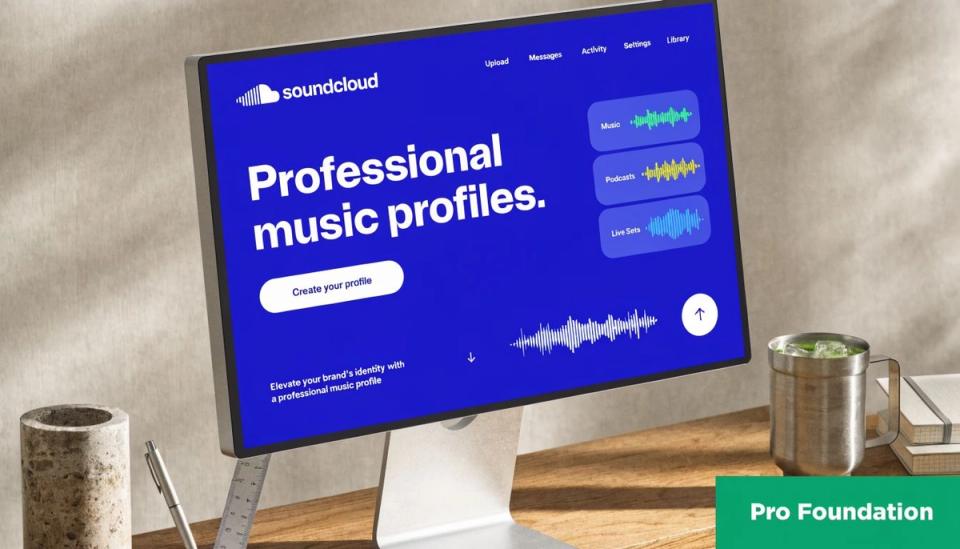
Write a bio that sells fit, not hype
Most channel bios are too vague. They say things like "supporting underground music" and leave it there. That doesn't help a label decide whether to send you a track.
Use the bio to state your lane, your offer, and your action. Keep it short. If you run melodic techno premieres and reposts, say that plainly. If labels are your main clients, say so. If individual artists mostly come to you for reposts, make that obvious too.
A solid bio usually includes:
- Genre focus – Name the exact styles you cover, not broad catch-alls.
- Submission route – Tell people whether to use a form, email, or booking page.
- Commercial intent – If you offer paid premieres or reposts, be direct about it.
- Trust signal – Mention release quality, curation standards, or channel history in plain language.
If you're still sending people to a messy profile with several dead links, fix that next. A guide on optimizing your social media bio link is useful because submission traffic drops fast when visitors have to guess where to click.
You should also give your main call to action one home. A dedicated page such as this link in bio setup for SoundCloud channels makes your profile easier to use for both labels and artists.
Practical rule: If a visitor needs more than one click to find your submission route, your page is costing you bookings.
Use your pinned track as proof of quality
Your pinned track shouldn't be random. It should show the exact standard of music and presentation your channel stands for.
For a premiere page, pin a release that reflects your ideal submission. Choose strong artwork, a clean title format, and a description that looks intentional. For a repost brand, pin something that shows your audience responds to your niche.
That pinned upload does more work than most channel owners think. It tells labels what kind of records belong on the page. It also tells listeners whether your feed has a point of view.
Fix metadata before you chase promotion
A lot of exposure problems are metadata problems wearing a marketing costume. If your tags are sloppy, your release starts weak before any repost goes live.
SoundCloud exposure guidance from Sonicbids notes that using quotes for multi-word tags like "melodic techno" can boost search validity by 60%, and putting your main genre tag first followed by 10-15 niche and mood tags can lift discoverability by 3x.
Use that properly:
- Lead with the main genre – Put the clearest category first.
- Add niche support tags – Include subgenre, mood, and context tags that match the track.
- Quote multi-word tags – This matters for search consistency.
- Keep title formatting consistent – Your catalog should look like one brand, not ten different upload styles.
Clean up the page like a business operator
You don't need to overdesign the page. You need it to feel reliable.
Here’s the short checklist I use mentally when judging whether a channel is ready for more exposure:
| Element | What good looks like |
|---|---|
| Profile image | Recognizable branding tied to your genre |
| Header and bio | Clear offer and submission instructions |
| Pinned track | Best-fit portfolio piece |
| Upload titles | One consistent naming format |
| Descriptions | Credits, context, and submission cues |
| Outbound links | One obvious route to submit or book |
A channel that looks organized gets better submissions. Better submissions lead to better releases. Better releases make every repost more valuable.
Develop a content strategy that builds your audience
A channel grows faster when premieres, reposts, and audience capture work together. If you only chase one-off placements, you'll stay busy but not build much.
Premieres build authority. Reposts add frequency. Download gates turn attention into a list, more followers, and stronger social proof.

Split your calendar by job, not by habit
A lot of channel owners post whatever arrives first. That creates a feed with no rhythm.
Treat each format as a tool:
- Premieres build your catalog and your taste profile. They make your page feel like a destination.
- Reposts keep your channel active between larger uploads and help artists who already have a live track.
- Gated downloads give each release a second purpose by collecting follows, likes, reposts, comments, or emails.
Many channels waste traffic. A strong premiere brings listeners in, then nothing captures them. If you offer a free download, use it with a clear gate so the release does more than generate a temporary spike.
A useful outside read on planning these systems is EvergreenFeed's content strategy tips. The value isn't in generic scheduling advice. It's in thinking about content as a repeatable publishing model.
Match the release type to the client
Labels and artists usually want different things from you.
Labels often care about presentation, context, and release framing. A premiere suits that because it gives the track a branded home and helps position the release. Individual artists often want fast distribution and visible engagement around an existing upload. Reposts fit that better.
That difference matters for exposure because it changes how listeners experience your page. Too many reposts and your channel starts to feel rented out. Too many premieres with weak curation and your standards drop. The feed needs both, but not in equal amounts every week.
A healthy channel doesn't publish everything it can. It publishes what keeps the niche clear.
Use network effects without turning the page into clutter
Premiere and repost networks still work because they put tracks in front of listeners who already care about the genre. This SoundCloud repost business breakdown shows that top-tier creators have achieved 300,000+ followers and 150 million+ streams through premiere and repost networks, and that a single placement on a channel with 190,000 followers can deliver thousands of plays.
That doesn't mean every paid placement is worth taking. It means network distribution works when the audience match is real. Genre fit is what keeps reposts from looking like noise.
Here’s the video if you want the broader business context behind that model:
Build a loop, not a feed
The strongest SoundCloud channels don't just publish. They compound.
A simple model looks like this:
- Book a premiere from a label that fits your niche.
- Support it with reposts through aligned partner pages.
- Offer a gated download to collect action from listeners who want the file.
- Follow up with the next related release while that audience is still warm.
That loop gives your channel memory. Listeners start to recognize the sound. Labels start to trust the audience. Your page becomes more than a timeline of isolated uploads.
Build relationships and manage your submission pipeline
The hardest part of running a premiere channel usually isn't promotion. It's keeping the pipeline clean enough to publish good music on time.
At first, the process feels manageable. A label emails a private link. An artist sends a DM asking for repost rates. Someone else follows up on a premiere date. You reply, tag the message, and promise yourself you'll update the spreadsheet later.
A month later, the mess starts showing. Two labels want the same day. One artist forgot artwork. Another sent the wrong master. Someone paid, but the payment note doesn't match the track title. Exposure suffers because the admin is now running the schedule.
Qualify submissions before you discuss placement
Good channel owners don't spend most of their time accepting music. They spend it filtering.
EDMProd's SoundCloud promotion guide describes a proven method for securing premieres: identify genre-specific channels, submit through the preferred route, and provide a complete package with the track link and genre information. It also notes that 70% of submissions fail due to poor genre fit. That number tracks with what many channel operators see in practice. Most inbox clutter comes from music that was never right for the page.
Use a basic review filter:
- Genre fit first – If it misses your lane, reject it fast.
- Release context second – Is this tied to an EP, label campaign, or standalone push.
- Asset quality third – Artwork, master, credits, and timing all need to be usable.
- Business fit last – Decide whether it belongs as a premiere, repost, or not at all.
Operational note: Fast rejections protect your brand as much as fast approvals.
Replace scattered messages with one intake path
Manual intake breaks because every client wants to communicate in a different place. Email, Instagram, private SoundCloud messages, and chat apps don't give you a reliable booking record.
The easiest fix is a single submission path with required fields. Even if you're still running part of the business manually, the request should come through one place. Ask for the track link, genre, release date, artwork, and whether the client wants a premiere or repost.
If you're still building that system, this guide to a music submission platform for SoundCloud channels is a practical reference for turning loose requests into a structured intake process.
Track the work like a release desk, not a fan page
A submission pipeline needs status labels. Without them, every follow-up becomes detective work.
Here's a simple example of how the queue usually looks in real life:
| Status | What you're checking |
|---|---|
| New | Did the client send complete info |
| Review | Does the track fit the channel |
| Approved | Is the placement type confirmed |
| Waiting on assets | Missing art, title, or final audio |
| Scheduled | Locked date and posting plan |
| Published | Live and ready for follow-up |
This is also where relationships matter. Labels remember reliable operators. If you answer clearly, reject politely, and publish on the agreed date, they come back with better music.
That repeat business is what stabilizes exposure over time. You stop relying on random inbound requests and start running a dependable release pipeline.
Automate your premiere and repost workflow
Manual booking works until it doesn't. The breaking point usually isn't dramatic. It's a series of small errors that stack up.
A client pays, but nobody marks the invoice. Artwork lives in one folder, audio in another. A repost is booked for the same hour as a premiere. Title formatting changes because two different people handled uploads. The channel still posts, but the operation starts leaking trust.
Stop treating admin like part of curation
Curating music is valuable work. Copying title formats into SoundCloud fields over and over isn't.
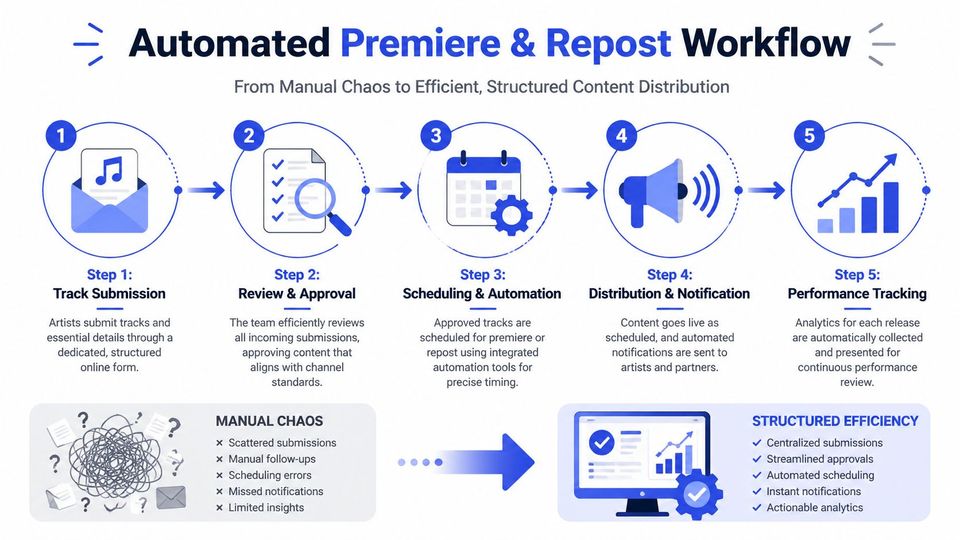
The manual stack usually looks like this:
- Inbox for submissions – Email, DMs, or both
- Payments in another tool – Often with separate follow-up
- Calendar somewhere else – Shared sheet, notes app, or booking tool
- Final upload by hand – Title, art, description, and publish timing entered manually
That setup creates friction at every stage. It also makes your channel feel smaller than it is. Clients don't just judge exposure by follower count. They judge it by how professional the booking flow feels.
Build one system from submission to post
A proper workflow for premiere and repost services should do four jobs in one place:
- Accept submissions through a structured form.
- Collect payments through Stripe Connect when needed.
- Schedule releases on a shared calendar.
- Publish to SoundCloud with the right metadata and assets.
That shift matters because it changes the job. Instead of handling repetitive admin, you spend more time reviewing tracks, checking fit, and planning release timing.
One practical option is Premierely's premiere scheduling tool, which is built for SoundCloud channel owners running premiere and repost services. It handles submissions, payments, scheduling, automated posting, and download gates in one workflow.
Automation reduces mistakes you won't catch twice
The biggest win from automation isn't convenience. It's consistency.
When the system controls required fields, clients stop forgetting basics. When scheduling happens in one calendar, overlap gets easier to spot. When posting is automated, title format and artwork handling become repeatable.
That consistency protects your brand in small ways:
- Submission quality improves because clients fill in the same required details every time.
- Payment tracking gets cleaner because placement status and payment status live together.
- Scheduling gets safer because your release queue isn't split across tools.
- Posting looks more polished because titles and descriptions follow a standard format.
The channels that look effortless usually have the strictest internal process.
Keep human judgment where it matters
Some owners resist automation because they think it removes taste from the process. It doesn't. It removes admin from the process.
You still decide what gets approved. You still set standards for artwork, genre fit, and release timing. You still choose whether a track deserves a full premiere or just a repost slot.
What changes is the amount of manual handling between yes and published.
Here's the trade-off in plain terms:
| Manual setup | Structured automated setup |
|---|---|
| More flexibility at the start | More consistency as volume grows |
| Harder to track clients and dates | Easier to track booking status |
| More room for custom handling | Better repeatability for common jobs |
| Higher risk of upload errors | Lower risk of missed details |
If you're only posting occasionally, manual work can limp along. If you're running regular premieres or paid reposts, it eventually slows exposure because the operation can't keep pace with demand.
Analyze performance to scale your channel's reach
Users often look at SoundCloud stats and stop at play count. For a premiere or repost business, that's too shallow.
The useful question isn't "Did this track get plays?" The useful question is "What kind of release earned engagement fast enough to justify another slot like it?"

Watch the first day closely
Early engagement matters because SoundCloud gives new tracks an initial push. SoundCloud's Amplify documentation says the platform amplifies eligible new tracks to around 100 listeners with matching interests, and that this happens in the first 24 hours.
For channel owners, that means the opening window is where you learn the most. If a track gets the right kind of reaction early, it has a better shot at carrying momentum. If it lands flat, don't just blame the algorithm. Check the fit, the timing, the artwork, the title, and the audience match.
Measure quality of response, not just volume
A repost service can generate activity without creating real traction. That's why you need to separate noisy releases from useful ones.
The metrics worth reviewing after each campaign are usually:
- Likes and comments early – They show whether listeners cared enough to react.
- Reposts from listeners or partners – Good sign that the release traveled.
- Follower movement around the release – Useful for judging whether the slot helped your brand.
- Download gate actions – If you use gated downloads, this tells you whether listeners took the next step.
A lot of this comes down to basic KPI thinking. If you want a useful refresher on making data-driven decisions, that framework helps because it forces you to define what success means before you post.
Use results to tighten your niche
Analytics should make your channel narrower, not broader.
If certain labels consistently bring stronger engagement, prioritize them. If one subgenre always underperforms on your page, stop forcing it because a client offered a booking. If repost campaigns drive plays but your gated premieres bring more followers and emails, adjust your release mix.
Better analytics won't fix weak curation. They will show you where weak curation keeps repeating.
A simple review habit helps. After each release, log what it was, who submitted it, what slot type it used, and how the audience responded. After enough releases, patterns become obvious. You stop guessing which clients, formats, and sounds extend your reach.
If you're running premieres or reposts as a business, Premierely gives you one place to accept track submissions, collect payments through Stripe Connect, schedule uploads, automate SoundCloud posting, and use download gates to turn releases into followers, social proof, and email signups.