Title tag: iZotope Trash 2 Guide for SoundCloud Premieres 2026
Meta description: Learn how izotope trash 2 shapes premiere-ready submissions and how to guide artists toward cleaner, harder-hitting SoundCloud mixes.
URL slug: /izotope-trash-2
izotope trash 2 shows up in premiere submissions for one simple reason. It helps producers add weight, grit, edge, and motion without relying on the same stock sounds as everyone else. If you run a SoundCloud premiere channel, knowing what this plugin does helps you judge whether a track sounds intentionally aggressive or just badly mixed.
That matters more than most channel owners admit. A lot of submissions arrive with heavy saturation, crunchy drums, torn-up basses, and strange spatial textures. Some sound expensive. Some sound collapsed and harsh. The difference often comes down to how the producer used distortion, not whether they used it at all.
For a curator, this is useful knowledge. You don't need to become a mix engineer. You do need the language to tell a label, "the top end is brittle," or "the bass distortion works, but the mids are smeared." That kind of feedback gets better music sent back to your inbox.
What is iZotope Trash 2 and why is it on my submissions
iZotope Trash 2 isn't just a distortion effect for guitars. It's a full sound-shaping plugin that producers use across drums, synths, pads, and vocals to push tracks from clean to ugly in a controlled way. That range is why it keeps appearing on electronic submissions.
The plugin was released as a redesign of the original Trash and includes over 60 distortion algorithms across a dual-stage Trash module, with up to four user-definable frequency bands per stage. It also supports AU, VST, VST3, RTAS, and AAX in both 32-bit and 64-bit formats, according to this product listing for iZotope Trash 2.
That technical range matters because producers aren't only using it for brute-force fuzz. They're using it to shape tone by frequency range. Low end can stay thick while mids get more bite and highs get texture. That's a big reason a submission can sound loud, dirty, and still feel deliberate.
Why channel owners hear it so often
If you curate electronic music, you're hearing the results of Trash 2 even when nobody mentions it in the submission notes.
Common use cases include:
- Drum bus weight – Kicks and snares get extra bite without turning the whole drum group into white noise.
- Bass character – Reeses, neuro basses, and midrange growls get more motion and edge.
- Synth enhancement – Pads and leads pick up warmth, fuzz, or a slightly broken texture that helps them stand out.
- Vocal treatment – Hooks and spoken samples can sound more urgent or more degraded, depending on the genre.
Practical rule: Distortion in a strong submission usually sounds chosen. Distortion in a weak submission sounds like it happened because the producer ran out of ideas and pushed everything too hard.
The useful distinction for a premiere channel is intent. Good distortion increases identity. Bad distortion hides arrangement problems, weak sample choice, or poor balance.
What works and what usually fails
Tracks benefit from Trash 2 when the producer uses it to create contrast. A clean breakdown into a torn-up drop works. A focused distorted bass under cleaner tops works. A saturated drum bus can work if the transient shape still reads.
What fails is broad, careless use. If every element is overcooked, the track loses depth. Your channel audience may not name that problem technically, but they'll hear it as fatigue. The track sounds "big" for a few seconds, then small because nothing has room left.
That's why izotope trash 2 matters to channel owners. It's one of the tools behind modern electronic tone. If you understand its fingerprints, you can sort bold production from messy production faster.
Decode the core modules and signal flow
Trash 2 makes more sense if you think of it as an effects rack, not a single stompbox. Audio enters, gets shaped in stages, then leaves as something cleaner, heavier, wider, dirtier, or more broken. The exact result depends on where the producer applies force.
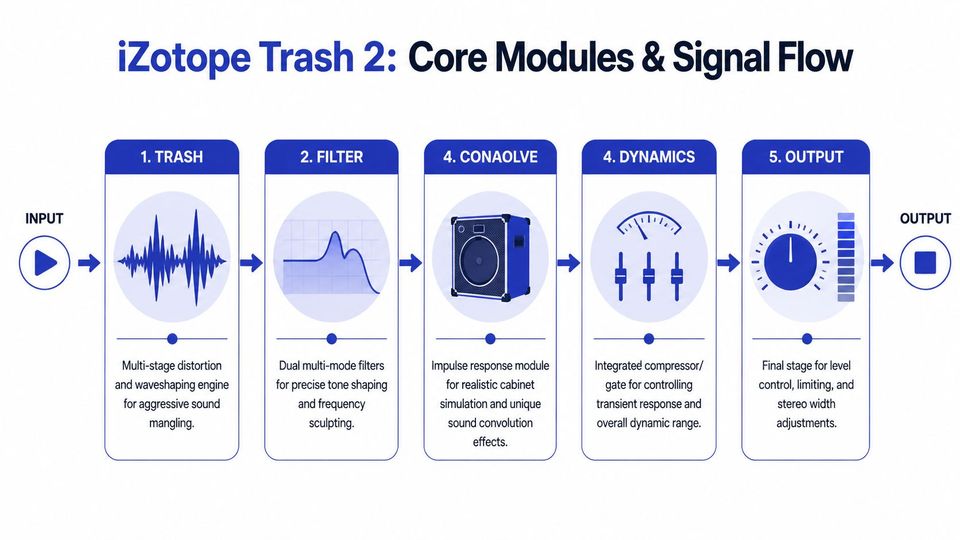
A useful mental model is this: split the sound by frequency, distort each part differently, then reshape what comes out. That's the core value of the plugin. According to this Trash 2 product page, it uses a multi-band distortion architecture with configurable bands, lets each band chain two distortion stages from over 60 algorithms, and includes over 100 impulse responses in the Convolve module, with convolution lengths up to 4 seconds at 48 kHz.
The modules that matter most
For curation, you don't need every knob. You need to know what each block tends to do to a submission.
| Module | What it does in practice | What you hear in submissions |
|---|---|---|
| Trash | Adds saturation, clipping, fuzz, and waveshaping | Crunch, bite, torn edges, denser harmonics |
| Filter | Shapes tone before or after distortion | Cleaner lows, tamed fizz, focused mids |
| Convolve | Applies impulse responses and unusual spaces | Cabinet feel, metallic tails, strange resonant texture |
| Dynamics | Controls transient response and level behavior | More control, tighter hits, less mess after heavy processing |
| Output | Sets final level and balance | Whether the effect lands as punchy or overloaded |
How the signal flow affects curation
The dual-stage distortion setup is where many premiere-ready sounds come from. One stage can add warmth or grain. The next can add aggression. If the producer gets the order right, the result sounds layered. If they get it wrong, the result sounds flattened.
The Convolve block matters more than many channel owners realize. It's often the source of those metallic, boxed-in, speaker-like, or oddly physical textures in techno, industrial, and bass music. If a track feels like the sound is coming through a device, a chamber, or a busted cabinet, this module may be the reason.
A lot of newer artists still miss the final cleanup stage. They distort a sound well, then leave too much fizz or boxiness after it. That's why some submissions feel exciting in solo moments but tiring across a full arrangement.
If you want context on how producers build large sounds with free tools too, this roundup of free VST plugins for music production is worth skimming. It helps you separate "good decisions with limited tools" from "expensive plugin, weak taste."
A strong signal chain sounds like each stage had a job. A weak one sounds like every stage tried to be the star.
Identify signature effects in premiere-ready tracks
The easiest way to spot izotope trash 2 in the wild is to stop listening for "distortion" as one thing. It usually shows up as a texture choice. Sometimes it's obvious. Sometimes it's the reason a plain sound suddenly feels expensive.

One well-known example comes from The Naked And Famous. Trash 2 gained visibility through its use on "Young Blood," where the Wrecktifier fuzz setting created the lead key line sound, as described in iZotope's own article on how The Naked And Famous use Trash 2 and Iris 2. That matters because it shows the plugin isn't only for punishment. It can define a memorable lead sound in a song people revisit.
Sounds that usually point to Trash 2
If you're reviewing submissions all week, these are the signatures worth learning:
- Focused drum crunch – The drums feel more forward and more expensive, but not blown out. The snare snaps harder, and the kick feels denser.
- Midrange bass movement – Bass tones seem to talk, smear, grind, or open up as they move through the phrase.
- Metallic or device-like space – The sound feels trapped in a cabinet, barrel, or odd physical object rather than a normal reverb space.
- Controlled ugliness – A lead or vocal sounds damaged, but the hook is still readable.
A real-world reference point
The same iZotope article also points to industrial-style uses, including Elektron Digitakt processing with presets like Remember Gak, which combines Fuzz, a Metal Barrel impulse response, and Dynamics. That combination explains a very specific sound many curators hear in darker submissions: the source gets grain, then an enclosed metallic body, then enough control to keep it from flying apart.
Here's the useful takeaway for your inbox:
| If you hear this | It often means |
|---|---|
| Thick bass with clear low end and nasty upper mids | The producer distorted selectively, not globally |
| Harsh top end that wears you out fast | The distortion wasn't filtered or balanced well |
| Interesting broken textures in fills and transitions | The producer used distortion creatively, not only for loudness |
| A whole mix that feels pinned flat | Distortion replaced dynamics instead of supporting them |
The best distorted tracks still leave you room to feel impact. If everything is angry all the time, nothing hits.
For premiere channels, this ear training pays off quickly. You stop rejecting tracks because they're dirty. You start rejecting them because the dirt doesn't serve the record.
Guide artists to mix with distortion for impact
Most bad premiere submissions don't fail because the idea is weak. They fail because the distortion ate the mix. That's fixable, and channel owners who can explain the fix become more useful to labels and artists.
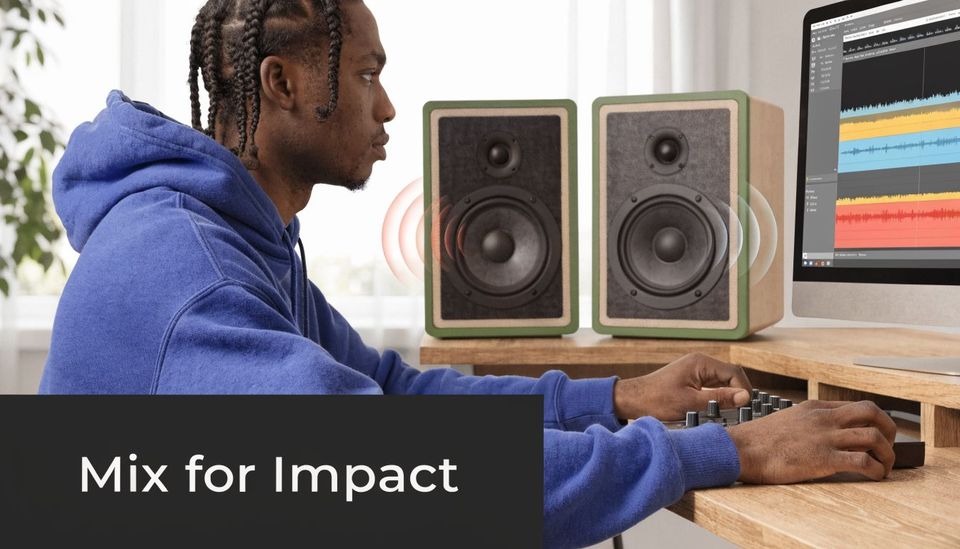
One practical point you can share comes from a Trash 2 product spec page. The plugin's dual-stage engine supports parallel processing, and a 50% wet blend on a bass bus with the Cactus fuzz algorithm can produce a 4-7 dB boost in low-end girth without mud. The same source notes that the XY pad can morph between distortion types with less than 1 ms latency. You can see those details on this Trash 2 specifications page.
That tells you something important. Producers don't need to print distortion at full force to get a bigger result. They often get a better mix by blending it.
Feedback that actually helps artists
A vague message like "mix needs work" wastes everyone's time. These notes are better:
- Tell them to distort in parallel – If the clean signal disappears, impact usually goes with it.
- Ask for selective distortion – Bass mids might need more aggression, while the sub needs stability.
- Flag harsh top end early – Fizz is one of the fastest ways to make a submission sound cheap.
- Watch the drop contrast – If the intro, break, and drop all share the same saturation intensity, the arrangement loses drama.
Producer note you can send: "The tone is strong, but the distortion is flattening your drop. Keep the aggression, then pull some of it back with parallel blend or band-specific processing."
What usually works best for premieres
Premiere tracks need to survive repeated listening. Your audience hears the artwork, title, and first few seconds, then decides whether the channel's curation is worth trusting. That means the distortion has to feel deliberate on headphones, monitors, and phone speakers.
A simple quality screen:
- Check the kick and bass relationship
If the low end turns cloudy when the drop hits, the distortion is probably spreading too far downward. - Listen to the hats after the first impact
If the top end feels splashy or brittle, the track may need cleanup after the distortion stage. - Notice whether the lead still reads
Distorted leads should still carry melody or motif. If the hook turns into static, the processing won. - Compare first drop and second drop
If automation changes the distortion character over time, the arrangement usually feels more alive.
For artists trying to improve online presentation as well as sonics, this guide on mastering sound online for music releases is a solid companion read.
This walkthrough shows the kind of movement producers often chase with Trash 2:
The bigger point is simple. Distortion should create identity and impact. It shouldn't hide a weak mix or replace arrangement dynamics.
Use download gates to share your own custom presets
If your channel has a defined sound, your taste already has value outside the uploads themselves. One practical way to package that value is to build a small bank of Trash 2 starter presets and offer them through a gated download.
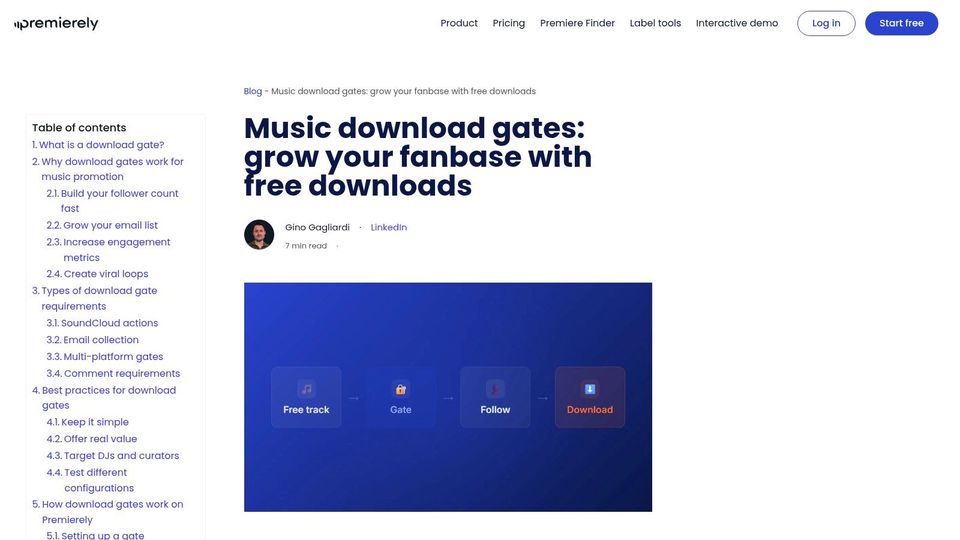
This works especially well for premiere and repost channels that get regular submissions from emerging producers. A preset pack doesn't need to be huge. It just needs to be useful and clearly voiced. Think in terms of starter sounds that reflect what your audience already trusts your channel to curate.
Preset ideas that fit a channel brand
A good pack is specific. Generic names feel disposable. Better examples look like this:
- Warehouse kick driver – Tightens a kick's front edge without turning it into a click.
- Broken pad wash – Adds grit and motion for intros and breakdowns.
- Lead tear upper mids – Pushes a hook forward without burying the rest of the arrangement.
- Metallic percussion frame – Gives percussion a harsher body for industrial or dark techno cuts.
You don't need to present them as magic fixes. Present them as starting points. That keeps expectations realistic and attracts better producers, not just beginners looking for shortcuts.
Why this helps the business side of your channel
A gated preset pack gives listeners a reason to take an action beyond passive listening. They can follow, like, repost, comment, or join your email list in exchange for the download. That's useful if you're trying to build a more dependable audience around your premiere channel instead of relying only on one-off traction.
If you're posting these offers regularly, it's also smart to understand how visibility systems behave. This guide on understanding platform algorithms and potential shadowbanning is worth reading so your distribution habits don't work against your content.
Give away something that reflects your channel's ear, not random leftovers. That attracts the right submitters.
You can also pair a preset pack with a free edit, bootleg, or sample tool to make the gate more appealing. This article on using download gates for free beats and music assets shows the broader logic well.
A few practical rules keep this from turning into fluff:
- Keep the pack small – Curated beats bloated.
- Write plain notes – Tell producers what each preset is for and what usually needs adjusting.
- Use your actual sound – If your channel leans deep, broken, heavy, or melodic, the presets should match that.
- Ask for better submissions – Include a short note that says you want producers to use the pack as inspiration, not as a crutch.
That last part matters. A good download gate can build community and improve submission quality at the same time.
Conclusion
Understanding izotope trash 2 makes you better at one of the hardest parts of running a premiere channel. You start hearing the difference between intentional sound design and a messy mix. That changes how you review submissions, how you reply to labels, and how much trust your audience puts in your uploads.
You don't need to know every algorithm. You do need to recognize the common patterns. Heavy bass distortion can work. Drum bus crunch can work. Damaged leads can work. But only if the track still has shape, contrast, and room to breathe.
That's the curator's edge. Better notes bring back better revisions. Better revisions make for better premieres. Better premieres strengthen the business behind the channel.
The admin side still needs structure. If you're handling submissions, payments through Stripe Connect, scheduling, and SoundCloud posting by hand, you're spending time on the wrong work. A proper premiere booking platform gives you more room to focus on curation, client communication, and the actual sound of the records you approve.
If you run premieres or reposts as a real business, Premierely gives you one place to accept track submissions, collect payments, schedule uploads, automate SoundCloud posting, and use download gates to collect emails, follows, likes, reposts, and comments.