The indie music definition matters more than most curators admit. If you run a SoundCloud premiere channel, you’ve seen the problem. One label sends a raw dream pop record, another sends polished melodic house with “indie” in the pitch, and an artist with major distribution still calls their track indie because of the vocal tone. If your definition is fuzzy, your channel identity gets fuzzy too. If your definition is clear, you filter faster, write better submission rules, and attract the kind of labels and artists that fit well.
Define ‘Indie’ to Build a Stronger Channel Identity
For a curator, “indie” has two meanings. The first is business structure. The artist is independent, self-releasing, or working with a small label outside the major label system. The second is sound. The track carries the texture, mood, and creative choices people associate with indie, even if the business side is more complicated.
That split is where most submission problems start.
A lot of channels say they want indie, but they never define whether they mean independent ownership, indie aesthetics, or both. That leads to weak booking decisions. You approve tracks that confuse your audience, and you reject tracks that would have worked if your criteria were tighter.
Separate business indie from sound indie
I treat indie as a practical sorting tool.
| Submission type | What it means for curation | What usually goes wrong |
|---|---|---|
| Independent release | Artist or small label controls release path | Curator assumes independent always means sonically indie |
| Indie sound | Lo-fi edges, unconventional structure, intimate mood | Curator ignores business fit and books mismatched clients |
| Both | Strongest match for most indie-focused channels | Fewer conflicts in branding and audience expectations |
This helps in daily review. A track can be independent and still sound too polished for your page. A track can sound indie but come through a bigger operation with a press cycle that doesn’t match your audience. Both cases are workable, but only if you know what your channel stands for.
Practical rule: Write your channel brief so a label can tell in one read whether you mean indie as ownership, indie as sound, or a narrow subgenre inside both.
Your branding gets stronger when your definition gets narrower. “Indie” alone is too broad for serious curation. “Indie electronic with lo-fi textures and melancholic vocals” is useful. “DIY indie rock and bedroom pop from small labels” is useful. Broad language brings broad submissions.
Turn a vague niche into booking criteria
A good indie channel brief usually answers four things:
- Sound first: What sonic traits belong on the page.
- Client fit: Whether you prefer artist-run labels, self-releases, or both.
- Release context: Whether you want premieres for upcoming EPs, singles, or catalog reposts.
- Audience promise: What a listener should expect every time they hit play.
If you’re still managing this by email, it’s worth seeing how other operators start a SoundCloud promotion channel with a clearer niche from day one.
Most channels don’t need more submissions. They need better-matched submissions. A sharp indie music definition is how that starts.
Trace the Origins and Evolution of Indie Music
You open your inbox and see ten tracks tagged indie. One sounds like bedroom pop recorded in an apartment. One comes from a boutique label with clean press assets and a release calendar. One is basically alt-pop with an “independent artist” line in the pitch. If you run a SoundCloud premiere channel, that mix only makes sense once you know how indie got here.
Indie started as a business position before it became a listening tag. One early marker came in 1977, when the Buzzcocks released Spiral Scratch. According to Chartmetric’s look at indie music’s evolution, it was the first indie self-released record to reach the UK Top 40. That mattered because it showed artists could press, distribute, and build demand outside the major-label system.
In the 1980s, college radio, local scenes, and small distributors kept that model alive. The sound varied a lot. The shared trait was control. Artists worked with tiny budgets, handled more of the release process themselves, and built audiences through communities instead of mass-market promotion.
By the 1990s, indie had expanded from a release model into a broader cultural label. Grunge, Britpop, and other scenes reached large audiences while still borrowing the older independent ethic. Some artists stayed fully independent. Others moved into bigger systems without dropping the aesthetics or values that made listeners read them as indie in the first place.
That shift matters for channel owners because it explains why “indie” creates so much confusion in submissions. Some artists use it to describe ownership. Others use it to describe taste, production choices, or scene affiliation. Both uses have history behind them.
Scale changed again in the digital era. Distribution got cheaper. Recording got easier at home. Discovery moved from local gatekeepers to platforms, niche communities, and algorithmic recommendation. For SoundCloud curators, that changed the job. You are no longer sorting a small subculture. You are filtering a huge pool of artists who can release professionally without a major.
Chartmetric’s report also notes that in 2024, indie artists accounted for 35% of global recorded music revenues, totaling $127 billion. The same report says indie representation in the Top 1000 artists by Chartmetric Score reached 41%, up 13% from five years prior, compared to 59% for major-signed artists. The same report also notes that over 50% of music consumed on major platforms in 2025 came from unsigned artists.
For a premiere channel, those numbers are not trivia. They explain why your indie lane gets crowded fast, why genre labels drift, and why a weak definition attracts the wrong records. I see this constantly. As soon as a tag gets commercial value, artists, managers, and small labels stretch it to fit their release.
After the first DIY wave, indie did not disappear. It became an operating model that adapted to new tools. The artist might upload through a digital distributor instead of mailing vinyl to shops. The label might be a two-person team running release plans from a laptop. The core logic is still recognizable: keep more control, build direct audience connection, and release without waiting for institutional approval.
This short clip adds useful cultural context before you judge current submissions against older expectations.
Read current pitches through that history and the inbox gets easier to manage. A modern indie track can come from SoundCloud, Bandcamp, or a small digital label and still fit the tradition if the project shows independent decision-making, scene awareness, and a clear artistic identity. That is the useful takeaway for curation. Indie is not one era or one sound. It is a long-running set of release habits, aesthetic signals, and business choices that still shape who belongs on your channel.
Identify the Musical Traits That Define the Indie Sound
A good curator shouldn’t rely on metadata alone. You need to hear the indie traits in the record.
The fastest way to do that is to stop asking whether a song is “indie enough” in the abstract. Ask what choices the artist made. Did they leave rough edges in place. Did they avoid a formulaic pop structure. Do the vocals feel exposed, textured, or deliberately understated. Those choices usually tell you more than the pitch email.
Listen for production that keeps the human element
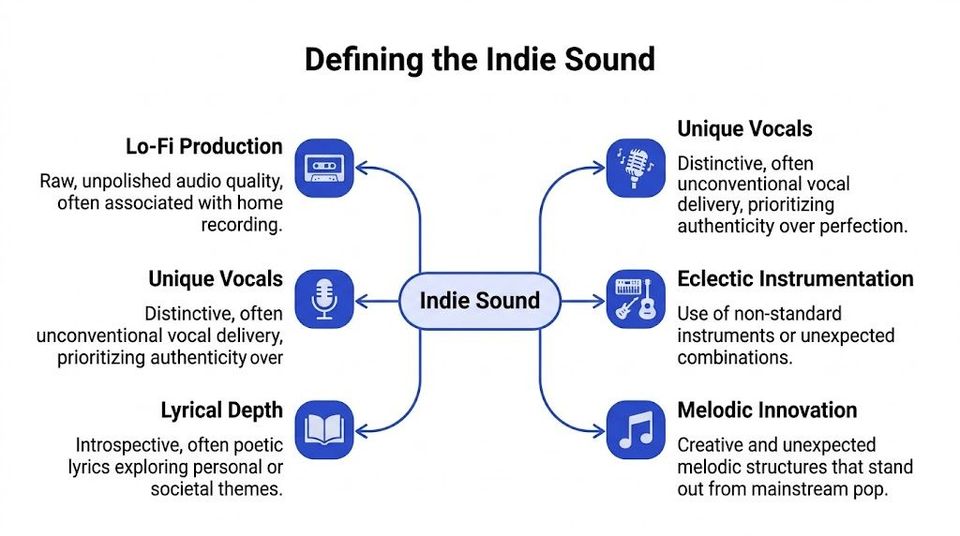
According to Octiive’s description of indie music, experimentation is a core technical specification of indie music. Artists often use lo-fi techniques like intentional distortion or unconventional arrangements to create a human aesthetic that stands apart from mainstream pop. That’s a useful listening lens for curation.
Here’s what that sounds like in practice:
- Rough texture: Tape hiss, room noise, clipped transients, or saturation that feels intentional rather than careless.
- Vocals as character: Not always big, polished, or dominant. Sometimes the vocal sits inside the music instead of floating above it.
- Arrangement risk: Fewer obvious drops, less formula, and more willingness to let a song drift, build slowly, or end without a hard payoff.
- Emotional directness: Lyrics and delivery often feel inward, personal, or uneasy instead of optimized for instant hooks.
A lot of curators miss the distinction between weak production and deliberate texture. Indie doesn’t mean unfinished. It means the artist chose feel over maximum polish.
If the roughness adds identity, keep listening. If the roughness hides a weak track, pass.
Tag by sonic lane, not by umbrella term
“Indie” is too broad to be useful as your only category. The better move is to split submissions into smaller lanes that match listener intent.
| Sonic lane | Common traits | Better fit for |
|---|---|---|
| Indie rock | Guitars forward, live drums, raw dynamics | Guitar-focused channels and label premieres |
| Dream pop | Hazy vocals, soft edges, atmospheric layering | Mood-based channels and late-night audience slots |
| Bedroom pop | Intimate vocals, minimal setup feel, personal writing | Artist-driven pages and younger discovery audiences |
| Indie electronic | Synth-led, off-center structure, lo-fi digital textures | Electronic premiere channels with crossover listeners |
| Synthwave or vaporwave crossover | Nostalgic synth palettes, stylized mood, DIY presentation | Channels that blend electronic promotion with indie aesthetics |
Octiive also notes that targeting indie electronic tracks with vaporwave or synthwave elements can be a smart fit for premiere services because that authenticity often sees stronger engagement in those circles. That’s especially true when your channel audience already expects mood, texture, and experimentation.
Build a review checklist you can actually use
When I assess an indie submission, I usually sort it through this order:
- Does the texture feel intentional
- Does the arrangement avoid obvious copycat structure
- Does the vocal delivery support the emotional tone
- Can I place it inside a specific lane on the channel
- Will my audience understand why this track is here
If you can’t answer the last point quickly, the problem usually isn’t quality. It’s fit.
That’s why booking systems matter. You need the audio, artwork, notes, and release context in one place so you can judge the whole package, not just the waveform. For curators handling regular volume, that’s much easier when submissions are collected through a proper premiere booking platform.
Recognize the Business of Indie from DIY to Digital Labels
A label sends you a track at 11 p.m. They do not ask for a vague feature. They ask whether you can hold a premiere on Tuesday, tag the release correctly, and help the song reach the right pocket of listeners before it hits DSPs. That is the business side of indie, and channel owners who understand it make better curation decisions.
Independent releases are usually run by small teams, solo artists, or digital-first labels handling tight budgets and limited time. That changes what they buy from a SoundCloud premiere page. They are paying for fit, trust, timing, and scene credibility. If your page looks organized and your niche is clear, you are more useful to them than a larger channel with sloppy positioning.
Small budgets change promotion behavior
The DIY side of indie came from artists recording outside major-label systems. As Audio Network explains in its overview of indie music features, cheaper recording tools lowered production costs and gave artists more creative control. That history still shapes how indie acts promote music now.
They rarely need broad exposure for the sake of numbers. They need the right placement in the right lane.
For a SoundCloud premiere owner, that distinction matters. An indie folk artist, a bedroom pop duo, and a small electronic label may all call themselves indie, but they buy different forms of support. One wants a premiere to frame a narrative around a release. Another wants a repost to add social proof. A label may want both, tied to a release calendar and coordinated artwork.
Your channel is part of the release operation
Once a track is approved, your page becomes part of the rollout. That means indie clients judge you less like a hobby curator and more like a small media partner.
In practice, I see three buying patterns:
- Small labels want release coordination. They care about schedule, metadata, artwork, and whether your audience matches the record.
- Self-releasing artists want flexibility. They may need a repost, a selective premiere, or a free-download push that helps early traction.
- Managers and assistants want process. If they cannot tell how to submit, pay, and confirm delivery, they move to the next channel.
That is where a lot of channels lose good music. Taste gets attention. Process closes deals.
A messy inbox makes your channel look smaller than it is. If you are reviewing regular volume, it helps to organize SoundCloud submissions in one workflow so artists can send audio, artwork, release notes, and timing without chasing you across DMs and email threads.
If you charge for placements, payment has to feel standard and low-friction. Indie clients will accept clear pricing faster than vague negotiation, especially when they are comparing several channels at once. It helps when they can submit tracks, pay through Stripe Connect payment processing, and get booked without extra back-and-forth.
The trade-off is straightforward. Smaller DIY acts value flexibility because their plans change fast. Better-funded indie labels value consistency because missed dates affect the whole campaign. Strong premiere channels handle both without blurring their standards.
Use the Indie Definition to Attract High-Quality Submissions
A strong niche does half your filtering before you even press play.
Most weak submissions happen because your page says “send music” instead of saying exactly what belongs. If your channel covers indie electronic, melancholic dream pop, or DIY guitar music, say that plainly. The sharper the language, the fewer irrelevant tracks you review.
Write submission rules that do the filtering for you
Your bio, booking page, and pinned post should all reflect the same indie music definition. Don’t use abstract language like “unique vibes” or “fresh sounds.” Use terms that describe what you approve.
A practical submission brief often includes:
- Accepted sounds: Name the lanes you book most often.
- Hard no list: Mention obvious mismatches so people self-filter.
- Release context: State whether you prioritize premieres tied to upcoming EPs or also accept standalone singles.
- Audio standard: Ask for private SoundCloud links or finished masters, depending on your process.
- Visual standard: Mention artwork requirements if your page depends on a consistent look.
If your inbox is still a pile of DMs, forms, and email chains, it helps to organize SoundCloud submissions around one process instead of chasing files across platforms.
Use tags and descriptions to support discovery
A lot of curators tag too broadly. They write “indie” and stop there. That wastes the strongest part of niche curation.
Use descriptive combinations that match both sound and audience intent. A track might need “indie electronic,” “lo-fi,” “dream pop,” or “synthwave crossover,” not just the umbrella label. Your title and description should also explain why the track belongs on your channel. That helps listeners trust your curation and helps submitters understand your taste.
Here’s a simple comparison:
| Weak positioning | Better positioning |
|---|---|
| “We post indie music” | “We post indie electronic, dream pop, and textured DIY records with melancholic vocals” |
| “Send demos” | “Send finished tracks for premieres, reposts, or release support” |
| “All genres welcome” | “No EDM festival tracks, no mainstream pop edits, no generic house” |
Turn niche listeners into owned audience
Indie audiences respond well to depth. If they like a subgenre, they often want the download, the follow, and the next release from the same lane. That’s where gated downloads become useful.
A download gate works best when the audience fit is already strong. If someone lands on a premiere that matches their taste, they’re more likely to trade an action for the file. You can require a follow, like, repost, comment, or email signup, depending on your release strategy.
Good curation makes the gate feel like access, not friction.
A great indie channel isn’t just collecting plays. It’s building a list, social proof, and repeat attention around a clearly defined sound. That’s much harder to do if your idea of indie changes every week.
Clarify Common Misconceptions About ‘Selling Out’
A lot of people still treat indie like a clean binary. Independent means indie. Major label means not indie. Real submissions don’t work that neatly.
The line is blurry, and that matters for channel owners. As noted in Wikipedia’s overview of independent music, high-profile acts like Tame Impala are often debated in exactly these terms. The same source notes that many artists signed to major labels retain creative control and are still considered indie, while “indie-labeled” tracks on majors are common.
Judge fit, not purity tests
For curators, the useful question isn’t whether an artist passed some purity test. The useful question is whether the track fits your audience and your brand.
That means you can accept an artist with larger distribution if the record still aligns with your sonic lane. It also means you can reject a fully independent act if the track sounds generic or out of place on your page.
A practical review frame looks like this:
- Audience match: Will your followers hear this as a natural fit
- Creative signal: Does the track still carry the experimentation or texture your channel is known for
- Client optics: Will booking this submission confuse your regular submitters or strengthen your positioning
The word “indie” now works as both a business label and a sonic label. Curators need to know which one they’re using at any given moment.
That nuance gives you more credibility, not less. Serious labels respect a curator who can explain a decision in clear terms. “Too major” is weak feedback. “Great track, but too polished for our DIY indie lane” is useful.
Turn Your Indie Curation into a Business
A good indie music definition does more than tidy up your language. It shapes the whole channel.
You book better releases when you separate business independence from indie sound. You keep audience trust when your uploads feel coherent. You attract stronger labels when your page makes clear what belongs and what doesn’t.
That clarity also changes operations. A niche channel with a real point of view shouldn’t run like a casual inbox project. It needs booking rules, payment handling, upload scheduling, and release coordination that match the standard clients expect. If you’re treating premieres and reposts as a real service, your process should reflect that.
That’s the gap many operators hit once submission volume rises. Taste gets them attention. Admin slows everything down.
If that sounds familiar, it helps to study what a real SoundCloud promotion business looks like when the backend is built around the work, not patched together from email, DMs, calendars, and manual uploads.
A strong channel identity is part editorial and part operations. Indie curation works best when both sides are tight.
If you run premieres or reposts seriously, Premierely gives you the system to match your taste. Accept track submissions, collect payments, and schedule uploads from one dashboard. Replace email chaos with a structured booking system, automate SoundCloud posting, and use gated downloads to collect emails or require likes, reposts, comments, and follows. It’s built for channel owners who treat premieres and reposts as a business.