If you run a premiere channel, new releases spotify strategy matters more than most submitters think. Labels often approach SoundCloud premieres like a one-off upload. That leaves value on the table. The channels that win treat a premiere as one part of a coordinated release plan, with Spotify, pre-save activity, metadata, and release-day timing all tied together.
That shift changes your offer. You stop selling a single post and start selling launch coordination. For label owners and curators handling steady submission volume, that makes your slot easier to price, easier to explain, and much easier to repeat with better clients.
Align your premiere service with Spotify's release cycle
Most label submissions arrive too late. The track is finished, artwork is rushed, the distributor window is closing, and they want a SoundCloud premiere tomorrow. That setup hurts both sides. You get a stressful booking. They get weaker Spotify support.
Spotify rewards organized releases. Spotify Wrapped 2025 showed how strongly new music drives attention on platform. Bad Bunny reached 19.8 billion streams, or roughly 54 million daily listens, which shows the scale timely playlist placement can create for releases on Spotify's platform (Spotify Wrapped 2025). Most independent labels won't touch that scale, of course. The lesson still holds. Release timing matters.
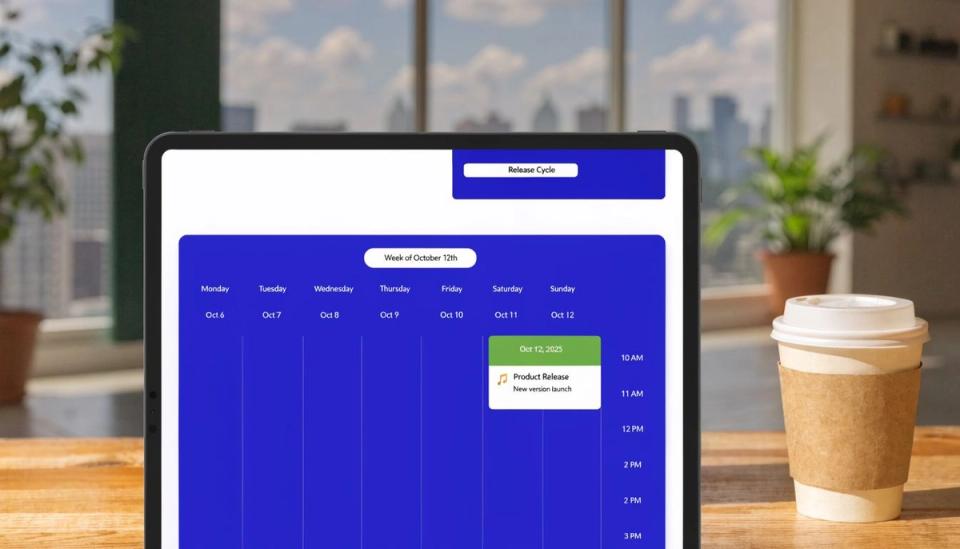
Sell a release window, not just a premiere slot
A strong premiere service starts with the calendar. I treat the premiere as one asset inside a release window, not the whole campaign.
That usually means building around:
- Distributor delivery early: The music has to be in Spotify's system with enough lead time for pitch prep and checks.
- Premiere date with purpose: The SoundCloud upload should support the Spotify campaign, not compete with it.
- Release day coordination: Friday still matters because Spotify's release rhythm and listener habits are built around it.
- First-week reporting: Clients care about what happened after launch, not just whether the track went live.
Practical rule: If a label sends a track too late to coordinate the Spotify side properly, I treat it as a basic upload job, not a premium premiere campaign.
That distinction helps with client quality. Better labels usually understand it right away. Less organized clients often improve once you give them a real process.
Work backward from Friday
Spotify's Release Radar updates every Friday. That simple fact changes how a SoundCloud channel should schedule work. If your client is trying to land in the strongest release pattern, your calendar needs to reflect that. If you need a refresher on how that playlist behaves, this breakdown of Release Radar on Spotify is worth keeping nearby.
Here’s the release logic I use with labels:
| Release stage | What the label should handle | What the channel should handle |
|---|---|---|
| Early planning | Final audio, artwork, credits, distributor upload | Confirm slot availability and audience fit |
| Pitch window | Spotify for Artists pitch, pre-save prep, social assets | Lock premiere date, headline copy, support plan |
| Week of release | Push snippets, links, artist posts | Queue premiere, final description, cross-platform callouts |
| Release day and week one | Share Spotify link, monitor listener response | Drive traffic from SoundCloud and report visible wins |
Your service distinguishes itself as more valuable than a repost page with a DM inbox. You understand sequence. You reduce bad timing. You stop accepting campaigns that were broken before they reached you.
Position your channel like a launch partner
A premiere channel that understands release timing attracts different submissions. Labels trust you with stronger records because you speak their language. You ask when the distributor delivery is done, when the Spotify pitch goes in, and whether the social schedule supports the slot.
That also protects your audience. Random uploads with no release plan usually underperform. Coordinated releases give listeners context. The artist posts. The label posts. The Spotify link is live. The premiere feels like part of something bigger.
The best SoundCloud premieres don't replace Spotify strategy. They give it an extra surface area.
That is the business case. You're not just filling your feed. You're helping labels package a release in a way that makes your slot more useful.
Prepare the track with perfect metadata
Bad metadata ruins good music every week. A lot of channels only check whether the WAV file arrived and whether the artwork looks acceptable. That's too shallow if you're trying to support a proper Spotify launch.
For new releases spotify planning, metadata is part of the product. If the title is messy, the artist names don't match, or the genre tags are off, the release starts weak before anyone hears it. Poor metadata also hurts algorithmic categorization. Mismatched genres can reduce categorization accuracy by 30-40% in algorithmic analysis, which makes it harder for the track to reach the right listeners on playlists like Release Radar (metadata impact on Spotify releases).
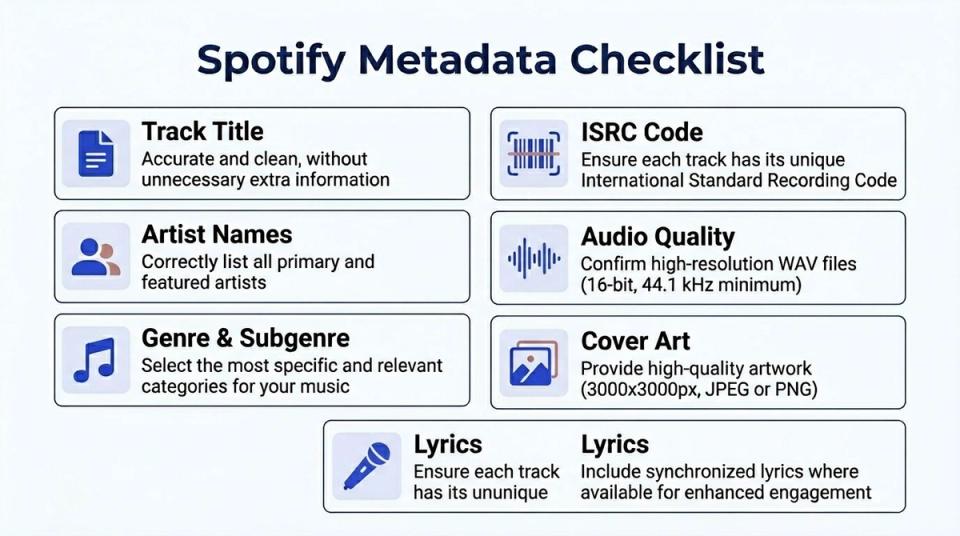
Use one intake checklist for every client
I prefer a fixed submission standard. If you let every label submit in a different format, errors spread fast.
The minimum intake pack should include:
- Final master: Lossless audio, named clearly, with no version confusion.
- Release title and track title: Clean and final. No last-minute renames after scheduling.
- Primary artist and featured artist credits: Written exactly as they should appear everywhere.
- Genre and subgenre: Specific enough to help Spotify categorize the release correctly.
- ISRC: One clear code per track.
- Artwork: High resolution and final.
- Lyrics if available: Useful for the release package, even if not every client provides them.
- Marketing notes: Short summary of what makes the track easy to present.
If you're checking metadata by hand, a dedicated audio metadata tool helps catch avoidable mistakes before the upload queue gets crowded.
Check the fields that actually break releases
Not every metadata field carries the same risk. I look hardest at the fields most likely to create downstream problems.
Here are the ones that usually cause trouble:
- Artist naming consistency
A featured artist missing in one place and added in another creates confusion across distributor pages, Spotify credits, and SoundCloud titles. - Genre inflation
Labels often want to tag broadly to catch more listeners. That's usually a mistake. If a melodic techno record gets tagged too loosely, the release may be shown to the wrong audience. - Version labeling
Terms like remix, edit, VIP, radio mix, and extended mix need to be accurate. If the file name says one thing and the public title says another, somebody will publish the wrong version. - Artwork mismatch
Premiere channels often receive a temporary cover first and a final cover later. That's how old assets end up live on release day.
A clean title and the right genre tag do more work than another paragraph of promo copy.
Match SoundCloud presentation to Spotify metadata
A common mistake is treating SoundCloud like a separate identity. It isn't. Your title format, description, artist credits, and visual presentation should reinforce the Spotify release, not drift away from it.
That means:
- Use the same artist spelling everywhere.
- Match the release title to the official release.
- Keep featured artists consistent.
- Avoid stuffing SoundCloud titles with extra promo text.
- Place the Spotify callout in the description cleanly, not as clutter.
The premiere often serves as a discovery surface before or alongside the official release. If a listener sees one title on SoundCloud and another on Spotify, trust drops immediately.
Build a metadata review into booking ops
Metadata review shouldn't depend on memory. It should sit in your booking process the same way artwork approval and payment confirmation do.
A simple review table works well:
| Checkpoint | What to confirm |
|---|---|
| Title review | Final wording matches distributor version |
| Credit review | Primary and featured artists are complete |
| Genre review | Primary and secondary style fit the track |
| Asset review | Audio and artwork are final files |
| Description review | Spotify release context is clear and not spammy |
Once you start doing this consistently, clients notice. They stop seeing you as a page that uploads tracks. They start seeing you as the person who catches release mistakes before those mistakes become public.
Pitch to Spotify's editors and algorithmic playlists
The Spotify for Artists pitch is the step too many labels rush. They spend time on teaser clips, then write the actual pitch in five minutes. That's backwards. If the release is serious enough to deserve a premiere slot, it's serious enough to deserve a proper Spotify pitch.
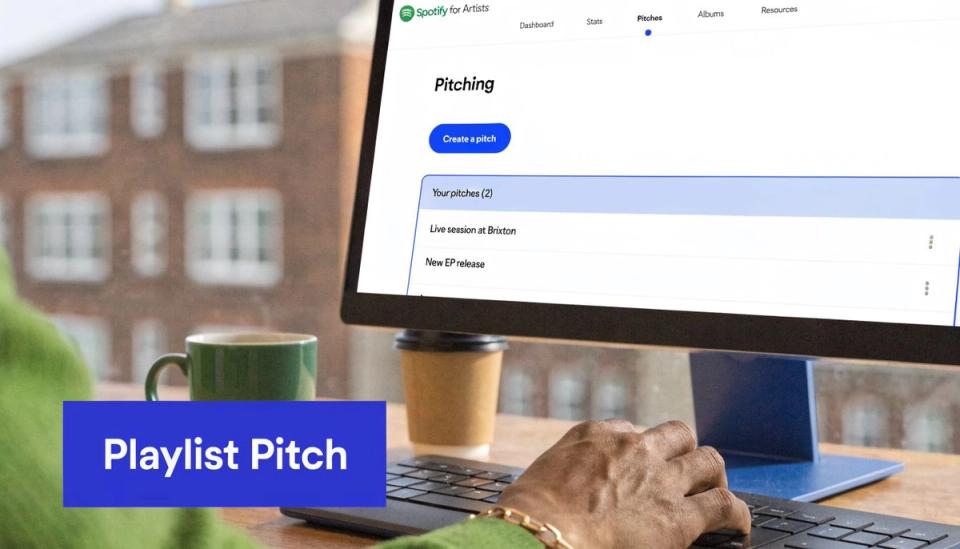
Tracks properly pitched through Spotify for Artists achieve 2-5 times higher initial streams among followers compared with tracks that aren't pitched, according to Spotify support data referenced here in the metadata section's source context. That is the strongest reason to make the pitch part of your client checklist, not an optional extra.
Help clients write a pitch that sounds like a team with a plan
Editors and algorithmic systems both benefit when the release context is clear. The pitch doesn't need hype language. It needs usable information.
A good pitch usually covers:
- What the track is: Genre, mood, and whether it's vocal or non-vocal.
- Why it matters now: Release timing, EP context, or artist momentum.
- Who is pushing it: Label support, artist channels, and scheduled promo touchpoints.
- What is already coordinated: Your SoundCloud premiere, social rollout, and release-week assets.
I tell clients to avoid vague lines like "this one will do numbers" or "fans are waiting." Those phrases don't help anyone place the record. A better pitch is concrete and short: label name, style, where it fits in the release, and what promo is already booked.
Mention the SoundCloud premiere as campaign proof
Your channel directly helps the Spotify side. A scheduled premiere shows that the track has external support and a planned story around release.
Useful details to include:
- premiere date
- channel fit by genre
- whether the artist and label are cross-posting it
- whether the premiere supports an EP or single release
- what traffic action the listener should take after hearing it
That makes the pitch feel real. It shows movement outside the dashboard.
Don't write a pitch like ad copy. Write it like release notes for a busy editor.
A lot of channel owners miss the service opportunity here. You don't need access to the client's Spotify for Artists account to improve the result. You just need to give them better material than "please support."
Give the client a usable pitch structure
I like a simple framework:
| Pitch part | What to say |
|---|---|
| Track identity | Specific genre, energy, mood, vocal or instrumental |
| Release context | Single, EP lead track, remix, or label showcase |
| Support plan | Premiere slot, artist posts, label activity, release-week push |
| Audience fit | Comparable listener lane without forcing named competitor claims |
After the client has the draft, I tell them to trim anything fluffy. If a sentence doesn't help Spotify understand the track or the campaign, cut it.
The mechanics matter too, and this video is useful if a client needs a visual walkthrough before submitting the pitch:
A related skill is understanding where playlist logic and listener fit overlap. This guide to Spotify playlist analysis is useful if you're helping labels think beyond one pitch and into audience targeting.
What doesn't work
Weak Spotify pitches usually fail for the same reasons:
- No release plan: The song is uploaded, but nothing around it is organized.
- No genre precision: The team describes the record too broadly.
- No proof of support: There is no booked content, no premiere, and no release sequence.
- Late submission: The team waits until the last minute and hopes for editorial attention anyway.
That last point is the killer. If the campaign starts late, your SoundCloud premiere can still help with visibility. It just won't carry the same weight as a release built on time.
Build hype with coordinated pre-save and premiere campaigns
A premiere channel already has what many labels need before release. You have attention from a style-specific audience. The mistake is using that attention only for release-day listening instead of pre-release action.
For new releases spotify campaigns, the strongest setup is a two-part motion. Your SoundCloud channel creates anticipation. The artist's Spotify page captures that anticipation through pre-saves, follows, and release-week listening.
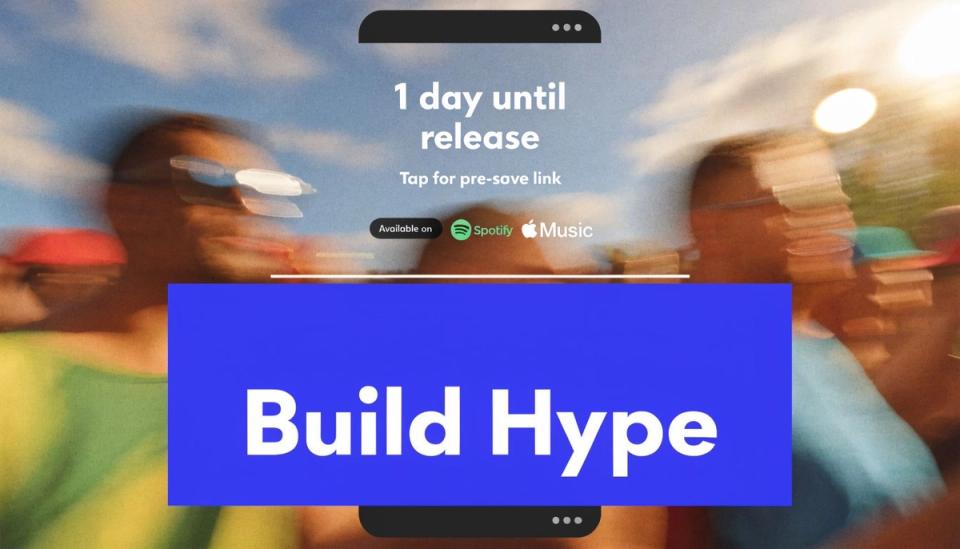
Spotify's recommendation system responds to hype signals. Marquee campaigns have delivered 10x cost-effectiveness compared with social ads for driving streams, while tracks with low save rates under 5% can have their algorithmic boosts cut in half (Spotify recommendation system guide). You may not be running Marquee yourself as a channel owner, but the principle matters. Early intent shapes what happens after release.
Use your channel to drive one clear pre-release action
Most hype campaigns fail because they ask listeners to do too much. Don't send people into five links, three snippets, and a vague caption. Give them one action at a time.
A clean sequence looks like this:
- Announcement post: Tell your audience a new premiere is coming and who it's for.
- Pre-save push: Ask for the Spotify pre-save before the premiere goes live.
- Premiere reminder: Bring them back to the SoundCloud post at the scheduled time.
- Release-day redirect: Move the audience to the full release on Spotify.
That creates a useful loop. The premiere benefits from anticipation. Spotify benefits from focused intent. The label sees that your audience can do more than just play an upload.
Package an offer labels understand
Labels buy clarity. If you're selling a coordinated campaign, explain the moving parts in plain terms.
For example:
| Offer element | Why it matters |
|---|---|
| Pre-release announcement on your channel | Signals that the record has support before launch |
| Scheduled premiere slot | Gives the release a fixed attention point |
| Spotify pre-save callout | Directs audience action before release day |
| Release-day description update | Sends SoundCloud listeners to the live Spotify link |
That's much easier to sell than "we'll post your track and see what happens."
Your audience is more useful to a label when you direct timing, not just traffic.
Add one incentive that fits your audience
Pre-save campaigns work better when listeners get something back. That doesn't mean bribing them with random extras. It means giving them a relevant reason to act now.
A few options work well:
- Alternative track gate: Offer another song from the artist as a gated download.
- Early clip access: Share a short unreleased section before the premiere.
- Artist pack or edit: Give listeners a bonus tied to the same release cycle.
- Email capture for future drops: Useful if your channel runs repeat premieres in one niche.
If you want ideas for structuring the countdown itself, this piece on pre-launch marketing strategies has useful timing concepts that apply well to release campaigns, especially when you're trying to keep attention warm between announcement and launch.
Keep the campaign narrow enough to execute
A lot of curators overbuild this stage. They promise too many assets, too many reminders, and too many custom edits. That creates admin drag and weak delivery.
A better pre-save campaign is small, repeatable, and consistent:
- one announcement
- one reminder
- one premiere post
- one release-day redirect
That is enough to make the SoundCloud side support Spotify without turning your booking calendar into chaos.
Coordinate release day and post-launch promotion
Release day is where disciplined prep shows up. If the track goes live on Spotify and your SoundCloud premiere lands hours later with an outdated description, the campaign feels disconnected. If both sides point in the same direction, the release feels intentional.
Friday is still the cleanest operating day for this work. Your SoundCloud premiere should support the live Spotify release, not sit in its own lane. That means checking links before publish, confirming final artwork, and making sure the track description points listeners to the official release.
Run a release-day checklist before the post goes live
I use a simple operational pass:
- Confirm the Spotify link is live: Don't schedule a dead link into the description.
- Check title parity: The SoundCloud title should match the official release.
- Review credits one last time: Featured artist mistakes are common on rush jobs.
- Update social copy: Artist and label posts should reference the same release language.
- Prepare a reporting note: Clients like fast summaries during the first week.
This doesn't need to be fancy. It needs to be consistent.
Push traffic both ways after launch
A good premiere post shouldn't trap listeners on one platform. It should point them toward the official release while still giving your audience a reason to engage on SoundCloud.
That means:
- keep the Spotify link near the top of the description
- ask the artist and label to repost or share the premiere
- update your own posts once the track is live everywhere
- watch the first week closely, because that's where release momentum is easiest to spot
If the artist is also building short-form support around the launch, a practical companion read is Rapper on TikTok: The 2026 Growth Playbook. It's aimed at artist growth, but the content ideas are useful when you're advising clients on how to keep attention moving after release day.
The first week tells you whether the campaign connected. After that, most reports become hindsight.
Report outcomes in a way clients value
Clients don't want a vague message saying the post went well. They want a short operational recap. Keep it plain.
A useful post-launch update includes:
- when the premiere went live
- whether the Spotify link was active at publish
- what artist and label support happened around the post
- notable listener response on SoundCloud
- any visible signs of traction from the artist side during week one
That recap is what turns a one-off booking into repeat work. It shows that you manage releases, not just uploads.
If you're running premieres or reposts as a real business, Premierely gives you one place to accept track submissions, collect payments through Stripe Connect, schedule uploads, automate SoundCloud posting, and use download gates to collect emails plus likes, reposts, comments, and follows. It's built for channel owners who want a structured booking system instead of an inbox full of release chaos.