
A music genre finder is only useful if it helps you run a better SoundCloud premiere business. Most channel owners don’t have a genre problem. They have an operations problem. Tracks arrive with vague labels, wrong subgenres, missing context, and no consistent review process. That leads to weak bookings, messy scheduling, and uploads that confuse your audience.
The fix isn’t trusting one tool. The fix is building a repeatable workflow. Human listening comes first. Audio feature checks come second. AI validation comes third. Then genre data needs to flow into your booking system, so every approved track carries the right metadata from submission to scheduled upload.
Stop letting bad genre tags hurt your channel
A label calls a track techno. You book it, prep the artwork, lock the date, and publish. Within minutes, regular listeners are telling you it sounds like progressive house. The track may still be strong, but the upload is wrong for the channel.
That kind of miss creates real operational drag. It blurs your lane, weakens trust with returning listeners, and leaves your archive full of releases that do not point in the same direction. For a premiere channel, genre is not just a discovery label. It shapes programming, audience expectation, and who submits to you next.
I learned to treat bad tags as a workflow problem, not a taste problem.
Labels often tag for reach. Artists tag for whichever term gets more clicks. Managers send broad descriptions because they are pitching ten channels at once. Some tracks genuinely sit between scenes, which makes clean labeling harder. If your review process accepts those tags without checking them, the queue gets noisy fast and your booking calendar starts filling with the wrong records.
Practical rule: Treat every incoming genre tag as a draft, not a fact.
That rule matters more once submissions scale. At low volume, one bad tag is an annoyance. At high volume, it wastes review time, creates avoidable back-and-forth, and pushes the right tracks further down the pile. I have found that genre detection works best when it supports decisions you already make. Does this fit the channel, the current schedule, and the audience you have trained?
Get the intake under control first. A structured system for organizing SoundCloud submissions gives you one place to review links, notes, and tags before anything reaches the calendar.
The goal is simple. Every approved premiere should arrive with a genre label you have checked, not one you inherited.
Run quick human checks to filter submissions fast
Friday afternoon is when weak tagging does the most damage. Ten new promos land, three say melodic techno, two say house, one says electronica, and half of them are chasing the wrong channel. If the first pass takes too long, the queue backs up and the right records wait behind tracks you were never going to book.

The fix is a fast human screen with clear rules. I want a reviewer to answer one question first. Does this sound close enough to the channel to justify a deeper check?
That only works if intake is organized. If submissions still live across inboxes, DMs, and label follow-ups, first-pass listening turns into admin work. Put everything into one review lane with a system to organize SoundCloud submissions so the reviewer sees the link, sender notes, and claimed genre in one place.
Listen for the fastest disqualifiers
The first check should stay under a minute. You are sorting, not writing a genre essay.
Start with the parts that reveal intent fast:
- Drum pattern: Straight 4/4 usually separates club-focused house and techno from breaks, garage, or leftfield rhythms.
- Bass behavior: A rolling low end, a swung groove, or a warmer bounce each points toward different lanes.
- Lead and hook style: Big melodic phrasing often changes the audience fit immediately. Tension-based repetition usually serves a different slot.
- Vocal use: Full toplines, chopped phrases, and sparse spoken lines each narrow the tag range quickly.
- Arrangement: Long intros and extended groove sections often signal DJ utility. Short intros and early drops usually signal a different release strategy.
A quick tempo check helps when the submission sits near the edge of your lane. BPM and Key Finder is useful for confirming whether a track belongs in the pile you are building or the one you should reject early.
Use a three-bucket decision
Do not force precision on first listen. That slows the team down and creates fake confidence.
| First-pass result | What it means | Next action |
|---|---|---|
| Clear match | The submission fits the channel’s programming lane | Approve for normal review |
| Clear mismatch | The tag or sound is off for your audience | Reject or reroute |
| Ambiguous | The track could work, but needs evidence beyond a quick listen | Hold for feature analysis |
This is the part many channel owners skip. They keep listening, hoping uncertainty will disappear. It usually does not. A three-bucket rule protects review time and keeps borderline records from clogging the booking calendar.
Train reviewers on channel fit
Academic genre accuracy is less useful than programming accuracy. A reviewer does not need to name every subgenre correctly. A reviewer needs to know whether the track belongs beside the last twenty premieres on the page.
That standard is easier to teach. Build reference points from your own archive. Pick five approved premieres that define your core lane, then compare new submissions against those records. If a promo sounds good in isolation but breaks the pattern your followers expect, it is still a weak fit.
Keep rejection language ready
Fast human checks only scale if the reply step is fast too. I keep short templates for the common outcomes so the team can answer without rewriting the same message all day.
- Too broad: “Good record, but it falls outside our current channel direction.”
- Wrong subgenre: “This sits closer to melodic house than the techno lane we are booking.”
- Borderline fit: “Strong track, but not close enough to the sound our audience expects from our premieres.”
Short, specific replies save time and preserve relationships. Labels may disagree with your call, but they can understand it. That matters when you want better submissions next month, not more noise.
Inspect audio features for objective analysis
Some tracks pass the ear test but still need a second layer. That’s where objective analysis helps. You don’t need a lab setup. You need enough measurable information to make a consistent decision.
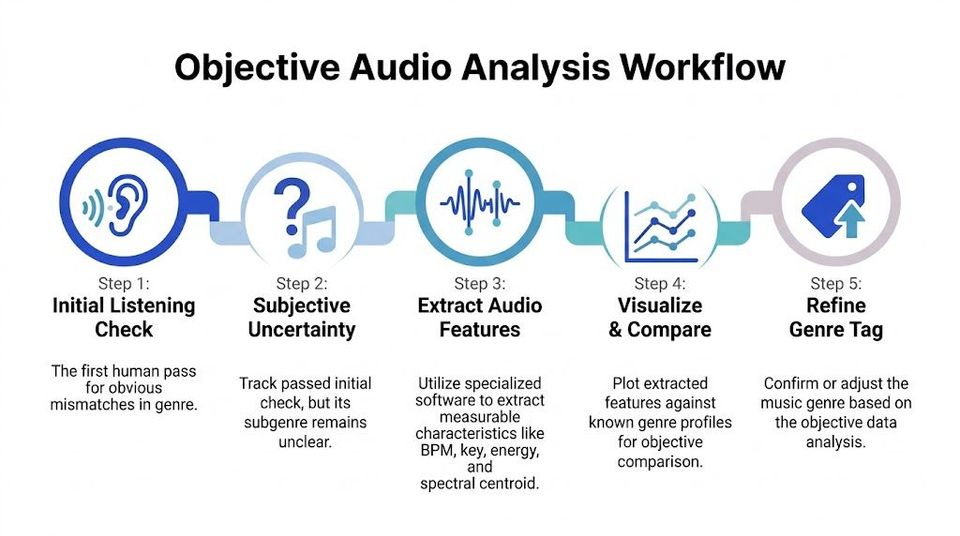
Start with BPM and key
Tempo is the fastest narrowing tool after listening. It won’t define genre by itself, but it removes bad guesses quickly. If a track sits much faster than your usual house submissions, or much slower than your usual techno lane, your shortlist changes.
For a quick read, I like using a practical browser tool such as BPM and Key Finder. It gives you a clean starting point when a label hasn’t provided reliable metadata.
A useful companion read is this breakdown of beats per minute software, especially if you want a more repeatable way to review incoming promo.
Use structure and energy to separate close cousins
A lot of confusion happens between adjacent electronic subgenres. BPM alone won’t settle that. You need to look at how the track behaves over time.
Check these points:
- Intro length: Longer functional intros often signal DJ-focused intent.
- Breakdown style: Big harmonic breakdowns can push a track toward melodic territory.
- Energy curve: Flat, hypnotic energy behaves differently from peak-drop writing.
- Density: Minimal drum programming and space create a different feel than layered percussion and stacked hooks.
Here’s a simple working table for common review situations:
| Subgenre lane | Typical BPM cue | Structure cue | Common confusion |
|---|---|---|---|
| House | Lower and groove-led | Vocal or chord-led sections | Melodic house, tech house |
| Techno | Higher and more driving | Long functional sections | Peak-time techno, melodic techno |
| Drum & bass | Much faster broken rhythm | Rapid drum movement | Breaks, halftime hybrids |
This table isn’t a rulebook. It’s a fast filter for repeat decisions.
Treat machine features as supporting evidence
Audio classification research uses MFCCs, spectral flux, and tempo as core features. In one benchmark, a Random Forest reached 97% accuracy on 2,000 GTZAN samples using combined features, while KNN reached 97.4% on 30-second clips versus 92% on 3-second clips. The same source notes that pop is often misclassified because hybrid styles blur boundaries, as shown in the IRJET paper on music genre classification.
That last point matters a lot for electronic submissions. Short clips can mislead you, especially when the intro is ambient and the groove arrives later. If the build takes time, don’t classify the record from the first few seconds.
Working habit: If the genre isn’t clear from the first pass, inspect a longer stretch before you tag it.
Keep your feature notes simple
You don’t need a spreadsheet full of research terms. A short note per track is enough:
- Tempo
- Key
- Energy note
- Main reference lane
- Secondary possible lane
That gives you a defensible basis for approval, rejection, or rerouting. It also keeps your decisions consistent across busy weeks when submission volume spikes.
Use AI to validate and scale genre detection
AI is useful when you treat it like a second opinion. It becomes a problem when you treat it like the final judge.
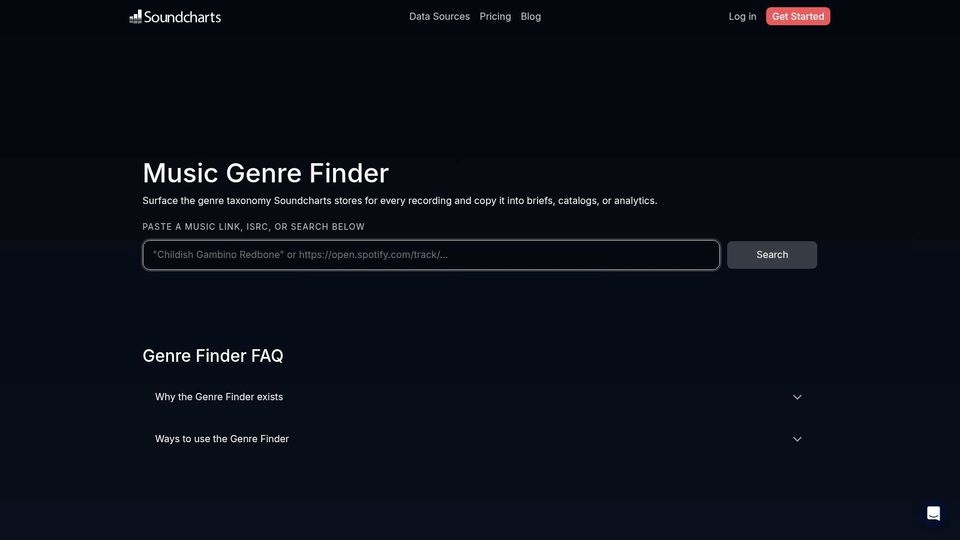
A good music genre finder can surface likely tags, related styles, and metadata faster than a human working from scratch. That helps when you’re reviewing a stack of submissions, especially if several tracks sit near the same border line. But genre tools still miss the operational reality of SoundCloud premiere channels.
One major gap is platform context. Current AI genre finders don’t explain how genre misclassification affects playlist placement, algorithmic reach, and audience targeting on SoundCloud, and they don’t really solve the problem of why one track might carry different tags across platforms, as noted in Soundcharts’ genre finder context.
Compare AI output against channel reality
Here’s the mistake I see most often. A curator runs a tool, gets a polished label like “melodic techno,” and copies it directly into their workflow. The tag may be technically fair, but it may not be the best choice for your channel audience.
Use AI output in this order:
- Confirm the broad lane
Check whether the tool agrees with your human triage. - Review alternate tags
If the model returns adjacent labels, note them. They often reveal crossover risk. - Map the result to your channel taxonomy
Your internal tag set should be tighter than the tool’s suggestion list. - Choose the SoundCloud-facing tag deliberately
Use the label your audience will understand and accept.
That last step matters more than people admit. A platform may support detailed tags, but your channel works best when tagging reflects how your listeners already group your catalog.
Build a platform-specific rule set
Spotify-style taxonomy and SoundCloud audience expectations don’t always match. A track can be classified narrowly on one platform and perform better under a broader parent tag on another.
A practical rule set looks like this:
- If the subgenre is obvious to your audience, use it
- If the track sits between two microgenres, post under the parent genre
- If the AI output conflicts with your archive, trust the archive
- If the submitter’s tag is promotional, not descriptive, ignore it
AI can label the sound. Only the curator can label the fit.
This is the part most tools skip. They help identify genres. They don’t tell you which tag will keep your channel coherent over months of premieres.
Don’t scale chaos with bad automation
Once you start processing more submissions, the temptation is to automate every decision. That’s risky. Bad assumptions spread quickly when they sit inside a repeatable system.
If you’re thinking seriously about repeatable validation layers, it helps to study broader principles around building reliable AI systems. The value isn’t music-specific. It’s the reminder that model output needs checks, rules, and clear human override points.
Use AI where it performs well:
- Batch validation: Good for checking broad consistency across many tracks
- Metadata support: Useful for surfacing likely style terms
- Triage support: Helpful when junior reviewers need a second reference
Don’t use AI alone for:
- Final channel fit
- Borderline crossover calls
- Brand-sensitive slots
- High-value paid premiere decisions
A reliable workflow doesn’t remove curation. It makes curation easier to repeat.
Create a fast batching process for submissions
Genre accuracy starts paying off when it changes how you handle volume. One-by-one review feels manageable at low volume, then turns into a mess once the inbox fills up.
Most genre finder tools stop at identification. They don’t tell you how to use genre data inside an actual promotion workflow. For channel operators, the hard part is using genre information to make booking decisions, set pricing tiers, route submissions, and standardize metadata across a large queue. That workflow gap is the key issue identified in this analysis of genre finder integration problems.
Batch by lane, not by arrival time
Chronological review is the default because it’s easy, not because it works. It forces you to jump from one sound to another all day. That lowers your judgment quality.
Instead, group submissions by working lane:
- Core channel fit
- Borderline but possible
- Wrong channel, reroute or decline
- Needs feature check
- Needs AI validation
This creates cleaner listening sessions. Reviewing several tracks from the same lane helps your ear stay calibrated.
Use a simple decision grid for approvals
Once tracks are grouped, booking gets easier because every decision sits in context.
| Queue group | Review style | Booking action |
|---|---|---|
| Core fit | Fast approval pass | Offer earliest suitable slot |
| Borderline | Compare against recent uploads | Book only if it supports channel direction |
| Needs more analysis | Technical review | Hold before promising date |
| Wrong fit | Quick decline | Send concise response |
That grid prevents overbooking weak fits just because they arrived first.
Standardize metadata before scheduling
A lot of admin waste happens after approval. The track is accepted, but the naming, description, and tag structure are still inconsistent. That creates extra cleanup before posting.
Keep one internal metadata format for every approved track:
- Primary genre
- Secondary genre if needed
- Mood or use-case note
- Label name
- Release context
- Final posting decision
Consistent metadata turns a random inbox into inventory.
Once you’ve got that, scheduling stops being reactive. You can build runs of related premieres, keep your feed coherent, and avoid posting three near-identical records back to back unless that’s intentional.
Match batching to business decisions
Genre data shifts from being purely editorial to having commercial value. Understanding which lanes dominate your queue allows for cleaner decisions regarding channel focus, booking standards, and the optimal application of manual review time.
For example:
- High-volume lane: Tighten acceptance rules so the feed doesn’t drift
- Weak but valuable niche: Reserve selective slots to keep authority there
- Cross-genre submissions: Create a hold group instead of forcing a rushed yes or no
That approach feels more like managing a catalog than reacting to promo mail. That’s the shift most channels need if they want to treat premieres like a business.
Automate genre tagging in your premiere booking system
The last step is connecting genre decisions to the system that runs your bookings. If your tagging process ends in a note app or spreadsheet, you’ll keep retyping the same information and repeating the same mistakes.
Historical genre datasets show how large and varied music classification gets over time. One analysis reports rock with more than 31,000 chart appearances, while electronic/dance logged between 3,430 and 11,467 entries across periods. For electronic promoters, that scale is a reminder that subgenre tracking isn’t optional if you want to target niche listeners effectively, as shown in the Million Song Dataset visualization summary.
For a SoundCloud premiere channel, that translates into a practical system:
Make genre a required intake field
Every submission form should ask for genre up front, but your internal workflow should treat it as provisional. The artist provides the first label. You approve, adjust, or replace it after review.
Route approved tracks by final tag
Once you assign the final tag, use it to sort the queue. That affects scheduling, copywriting, and which release sits next to which in your calendar. Here, a real music submission platform begins to matter, because the tag should move with the submission instead of living in disconnected tools.
Keep upload metadata tied to booking data
Approved genre tags should flow into the final posting record, alongside title formatting, description copy, and release timing. That cuts down on manual copy-paste work and reduces preventable tagging mistakes on publish day.
If your current setup still relies on inbox threads, separate payment follow-ups, and manual scheduling notes, genre work will always feel heavier than it needs to. The point of a music genre finder workflow isn’t only better labels. It’s fewer avoidable decisions once the track is approved.
Premierely is built for SoundCloud channel owners who treat premieres and reposts as a business. It helps you accept track submissions, collect payments through Stripe Connect, and schedule uploads from one dashboard, while also supporting download gates for likes, reposts, comments, follows, and email collection.