Figuring out Spotify royalties can feel complicated. Many artists and label owners get stuck on the per-stream rate, but this is often the wrong focus. There is no single, fixed rate. Instead, your payment comes from a small share of a large, changing revenue pool. This guide breaks down how that pool is created and divided each month.
How much does Spotify pay per stream in 2026?
Spotify pays between $0.003 and $0.005 per stream on average in 2026. There is no fixed rate. Spotify pools all subscription and ad revenue per country each month, keeps about 30%, and splits the rest among rights holders by their share of total streams. A track needs at least 1,000 streams in 12 months before it earns anything at all.
That average hides a wide range. A stream from a Premium listener in the Netherlands, the US, or the UK can be worth $0.005 or more. A stream from a free-tier listener in a low-subscription market can be worth under $0.001. The table below shows what moves the number.
| Factor | Higher payout | Lower payout |
|---|---|---|
| Listener plan | Premium subscriber | Free, ad-supported |
| Listener country | Netherlands, US, UK, Nordics | Markets with low subscription prices |
| Total streams that month | Fewer competing streams in the pool | Record-high platform streams |
| Rights split | You own master and publishing | Label and publisher take their share first |
| Track status | Past the 1,000-stream threshold | Under 1,000 streams in 12 months |
Remember that the per-stream number is what rights holders receive. Your distributor or label deducts its fee before the money reaches you, so the amount in your bank is lower than the headline rate.
Spotify royalties calculator: 1K to 1M streams
Use this table as a quick Spotify royalties calculator. It applies the 2026 average range of $0.003 to $0.005 per stream, before distributor fees. Real statements will land inside or near these bands depending on where your listeners are and which plan they use.
| Streams | Low estimate ($0.003) | High estimate ($0.005) |
|---|---|---|
| 1,000 | $3 | $5 |
| 10,000 | $30 | $50 |
| 100,000 | $300 | $500 |
| 500,000 | $1,500 | $2,500 |
| 1,000,000 | $3,000 | $5,000 |
| 10,000,000 | $30,000 | $50,000 |
Two things change these numbers in your favor. Owning your publishing adds the songwriter share on top of the master share, roughly 20% more per stream. And building your audience in Premium-heavy markets, which is where a SoundCloud premiere on a European channel tends to send listeners, raises your average rate without adding a single stream.
How Spotify calculates royalties
Spotify pays rights holders, not artists directly. The payment system is a "pro-rata" model that gathers all revenue before distribution. Your payment is based on your share of total streams, not a flat fee per play. This system is crucial for channel owners who treat premieres and reposts as a business.
Break down the pro-rata system
Think of a large pool for each country. Every month, Spotify fills this pool with money from Premium subscriptions and ads. For instance, there is a separate pool for the Netherlands, the US, and Brazil. Spotify takes its share first-about one-third-to cover its operational costs.
The remaining two-thirds of the money goes to music rights holders. This includes your label, publisher, and distributor. Your payment is your "streamshare" of this pool. If your tracks accounted for 1% of all streams in the Netherlands, your rights holders get 1% of the Dutch royalty pool. This is why the per-stream rate fluctuates monthly and by country.
Identify key factors that influence your earnings
Your final payment is always changing. For label owners using premiere services to promote tracks, knowing these variables is essential. These factors determine the value of a stream.
Here’s what affects a stream's value:
- Listener's location: A stream from a high-subscription market like the Netherlands is worth more. It contributes more money to that country's revenue pool. A stream from a region with lower subscription prices contributes less.
- Listener's subscription type: This factor is very important. Streams from Premium subscribers are worth much more than streams from listeners on the free, ad-supported tier.
- Total monthly streams: The total number of streams affects your share. If your stream count stays the same but total Spotify streams increase, your percentage share and payment decrease.
This model connects your music's value to your listeners' location and subscription. A key goal is to drive plays from high-value listeners. For channel owners, converting SoundCloud promotion into Spotify income means targeting fans in Premium-heavy markets. The Premierely premiere booking platform helps you manage and target these promotions.
Collect the two main types of royalties
Every Spotify stream generates money. This money is not a single payment. It is split into two separate royalty streams that flow to different people. Understanding this split is critical for artists and label owners to collect all their earnings.
Think of it like a movie. There's a royalty for the screenplay (the song) and a separate one for the film production (the recording). Spotify has publishing royalties and master recording royalties.
Master recording royalties: the payout for the finished track
This royalty is the most direct. Master recording royalties are paid for the use of a specific sound recording. It's the final "master" file you upload to a distributor. The money for this royalty goes to the owner of that recording.
This is usually:
- The record label, if an artist is signed. The label likely funded the recording and owns the master rights.
- The independent artist, if they funded and released the music themselves.
Your distributor, such as TuneCore or DistroKid, collects these master royalties. They deposit the funds into your account. This is the money most artists see on their distributor dashboard.
Publishing royalties: the payout for the song itself
This area is more complex and where artists often miss income. Publishing royalties are paid to the owner of the musical composition. This includes the melody, chords, and lyrics. One song can have many recordings, but they all originate from one composition.
Master royalties are for the recording, while publishing royalties are for the songwriting. Many artists mistakenly believe their distributor handles both. This error can lead to a significant loss of unclaimed earnings. This royalty is divided into two types.
Mechanical royalties
A mechanical royalty is generated each time a song is reproduced. On digital platforms, a stream is considered a reproduction. Every play on Spotify generates a mechanical royalty for the songwriters and their publisher.
Performance royalties
A public performance royalty is generated when a song is played in public. This includes radio, public spaces, and streaming on Spotify. A stream is a public performance, creating a separate royalty for the songwriter and publisher.
Collecting these publishing royalties requires action. In the Netherlands, songwriters must register with a Performance Rights Organization (PRO) like Buma/Stemra. This group tracks plays and ensures money gets from Spotify to the creators. Without registration, this income remains unclaimed.
Spotify royalty types and their payees
This table shows the royalties from a single Spotify stream. It details what they pay for, who earns the money, and who collects it.
| Royalty Type | What It Pays For | Who Earns It | Who Collects It |
|---|---|---|---|
| Master Recording | The use of the specific sound recording | The label or independent artist | The music distributor (e.g., DistroKid) |
| Mechanical | The reproduction of the song's composition | The songwriter(s) and publisher(s) | A publisher or collection society |
| Performance | The public broadcast of the song's composition | The songwriter(s) and publisher(s) | A PRO (e.g., Buma/Stemra in the NL) |
Your distributor only handles one part of the royalty puzzle. Without a publisher and a PRO, you are only collecting a portion of what your music earns.
Trace the path of royalty payments
You know there are two royalty types. But knowing what they are is different from knowing how money travels from a stream to your bank account. The path is not a straight line. It is a winding road with several important stops. To collect all your royalties from Spotify, you must know the route.
This diagram shows how money flows from a stream to the owners of the recording and the song.
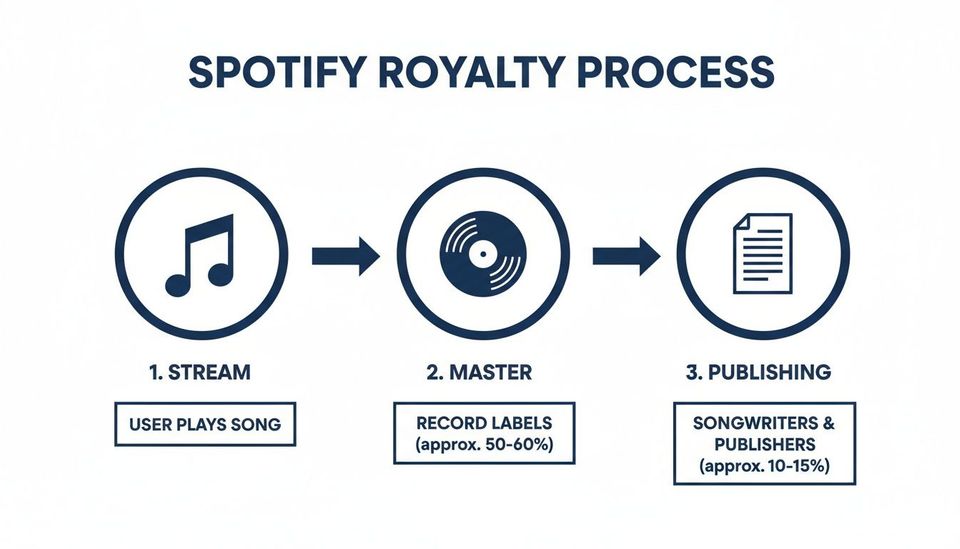
After Spotify takes its cut, the remaining money is split. It goes to the owners of the recording (master rights) and the song (publishing rights). These owners then pay the creators.
The initial payout from Spotify
It all begins in one large pool. Each month, Spotify pools all revenue from Premium subscriptions and ads in each country. Spotify takes its cut first, about 30%, to cover operating costs. The remaining 70% is paid out to the music industry.
This large payment goes to two distinct groups:
- Master Rights Holders: This is the larger share, paid for using the sound recording.
- Publishing Rights Holders: This is the smaller share, paid for using the underlying composition.
From here, the money travels down two separate paths.
The distributor's role in master royalties
The master royalty payment flows from Spotify to the recording owner. For independent artists or small labels, this means the money goes to your digital distributor. Companies like TuneCore or DistroKid act as your financial agents. They collect master royalties from Spotify and take a small commission before depositing the rest into your account.
This part of royalty collection is familiar to most artists. Your distributor's dashboard provides data on your earnings. It is the most direct financial link between your streams and your income.
The publisher and PRO's role in publishing royalties
Publishing royalties take a more complex route. Spotify pays this money to a system of organizations that collect it for songwriters and publishers. These are the main players involved.
These organizations include:
- Publishing Administrators: Companies you hire to collect all royalties your compositions earn.
- Performance Rights Organisations (PROs): Groups like Buma/Stemra in the Netherlands, which collect public performance royalties.
- Collective Management Organisations (CMOs): These bodies often collect mechanical royalties on a large scale.
These groups track every use of your songs on Spotify. They take their administrative fees and distribute the rest to songwriters and publishers. Setting up your Spotify for Artists account is a crucial first step in this process. Once the money reaches your bank, you must handle your taxes. US-based artists typically need to report your royalties on IRS Schedule E.
Why Dutch listeners are worth more per stream
Not all streams have equal value. For electronic artists, getting plays from the Netherlands is highly valuable. The country has a high density of premium subscribers. This means each play generates more income than streams from many other regions.
Your SoundCloud channel can become a serious business driver. Smart promotion on SoundCloud can direct listeners to Spotify. This boosts royalties in a measurable way. As a channel owner, you have a clear opportunity here.
Explain why Dutch streams are so valuable
The Netherlands has a strong music market where streaming is dominant. According to NVPI data, the total Dutch music industry revenue hit €334 million in 2024. This was a 12% increase from the previous year. A massive 83% of that-€278 million-came from streaming platforms like Spotify.
This growth is not slowing down, making the market a smart target. This financial reality makes the Netherlands a prime location for promotion. When a label pays for a premiere on your SoundCloud channel, they are investing in a chance to enter a profitable streaming market. Check out this detailed report on Spotify's record payouts for more context.
Shift from promotional cost to strategic investment
Let's examine how this works in practice. Globally, Spotify's average payout is around $0.004 per stream in 2026. In high-revenue markets like the Netherlands, that rate is higher. This is especially true for dedicated electronic music fans who are more likely to pay for subscriptions.
Imagine a techno track gets a premiere on your channel. It gains traction and lands on several Dutch-curated Spotify playlists. If that track gets 250,000 Dutch streams, the earnings become significant. At an average rate of $0.004 per stream, 250,000 streams generate about $1,000 in royalties. This one result can cover the cost of multiple premiere bookings.
Turn buzz into measurable returns
The key is to create a repeatable system. When labels and artists submit tracks to your channel, they are buying access to an audience. This audience can start a profitable cycle. Your job as a channel owner is to be the bridge that makes this connection.
Managing your bookings and schedule properly makes you a critical partner in their revenue strategy. This is why you should replace manual DMs and messy spreadsheets with a structured system. A premiere booking platform like Premierely lets you handle more submissions and focus on curating great music. The better your promotions perform, the better the artist's results, bringing them back for their next release. For more, see our guide on how to get on Spotify's Release Radar.
Register your music to collect every penny
Getting a track premiered is a major achievement, but the work is not done. A huge amount of Spotify royalty money is lost each year. This happens because the music was not registered correctly. This administrative issue costs artists and labels real money. Many people believe their distributor handles everything, which is a costly mistake.
Distributors are great at collecting royalties from the master recording. However, they usually do not collect the publishing royalties generated by the song itself. This money sits unclaimed. As a channel owner, you can offer real value here. You help artists build excitement. The next step is ensuring they can collect the money that excitement creates.
The essential registration checklist
To get paid for every stream, you need to connect with the right organizations. This is a mandatory step for your music business. Without these connections, your earned money has no way to reach you.
Here is the essential checklist for any serious artist or label in the Netherlands:
- Your distributor: This is the first step. A distributor puts your track on Spotify and collects your master royalties.
- A performance rights organization (PRO): In the Netherlands, this is Buma/Stemra. They track every stream and public play to collect your performance royalties.
- The mechanical licensing collective (The MLC): If your music gets plays in the United States, you must register with The MLC. They are the sole entity collecting digital audio mechanical royalties from US-based streams.
- A publisher or publishing administrator: This is the next level. A publishing administrator will track down all your publishing income from around the world.
If you skip these registrations, you are giving away a large part of your income. The money is there, but it does not know you exist.
Ensure your registration data is perfect
Just signing up is not enough. Your entered data must be completely accurate. A single typo in a song title or a misspelled writer's name can stop payments. Wrong ownership percentages can also cause problems.
In the Dutch electronic scene, Spotify streams are valuable. Per-stream payouts average around $0.004 in 2026. An artist not registered with their PRO and The MLC could miss up to 30% of their total earnings. This can mean hundreds of euros lost. Find more details on these per-stream payout details on Chartlex.com.
Connect promotion to payment
As a channel owner using a premiere booking platform, you already operate like a business. You have replaced DMs and emails with a professional booking form. You have automated payments with Stripe Connect. You are using download gates to collect emails and social proof.
Applying this structured approach to royalty collection is the next step. The excitement you create with a premiere is the first asset. The second is having a system to register the track correctly. This ensures every stream pays out its full value. Learn more about converting buzz to growth in our guide on moving your audience from SoundCloud to Spotify.
Debunk common Spotify royalty myths
Discussions about Spotify royalties are full of incorrect information. This confusion often leads to disappointment for artists and labels. To build a career, you must focus on the facts. Let's address the biggest myths.
Knowing what is real helps you focus on what actually generates income. It's time to separate fact from fiction.
Myth 1: Spotify pays a fixed rate per stream
This is a common and completely wrong belief. There is no fixed per-stream rate. You cannot simply multiply your play count by a single number to calculate earnings. Spotify uses a "pro-rata" system.
Think of all the money Spotify makes in a country each month as one big pizza. Your payment is your slice, determined by your "streamshare." Your share is based on how many of your streams occurred in that country compared to the total. This is why a stream from a Premium user in a high-revenue country is worth more.
Myth 2: you get paid instantly
You see streams increasing and assume money is coming soon. That is not the case. The process from a listener's play to money in your bank can take months.
Here is the general path:
- Collection: Spotify calculates and pays rights holders monthly.
- Processing: Your distributor or PRO receives a large payment and must sort out who gets what.
- Payout: They finally pay you on their own schedule, often quarterly.
The payment you receive today is likely for streams that happened three to six months ago.
Myth 3: my distributor collects all my royalties
This is a dangerous and expensive assumption. Your distributor, like DistroKid, is great at collecting your master recording royalties. But their job usually stops there. They typically do not collect your publishing royalties.
This includes the mechanical and performance royalties generated by the song's composition. If you have not registered your songs with a PRO like Buma/Stemra and a collection society like The MLC, you are leaving money unclaimed. This can amount to a third of your total earnings.
Myth 4: all streams are monetized
This is no longer true. As of 2024, Spotify has a new rule. A track must get at least 1,000 streams within a 12-month period to be eligible for royalties. The policy aims to reduce fake streams and ensure real artists are paid.
This change makes the initial promotional push more important than ever. A premiere on a popular SoundCloud channel can help a new track surpass that 1,000-stream threshold and start earning. In a key market like the Netherlands, streaming contributed €278 million in 2024. You can discover more insights about the Dutch music industry's revenue on hardnews.nl. For channel owners, a premiere booking platform like Premierely automates the administrative work. This allows you to focus on finding great music and helping artists turn their SoundCloud buzz into real income.
Answering your top royalty questions
Your tracks are on Spotify and the stream count is rising. Now you have the big question: where is the money? The world of Spotify royalties can be confusing. Let's provide straight answers to the most common questions.
How often does Spotify pay out?
You see daily streams, but payments are not weekly. This is a common point of confusion. Spotify pays rights holders monthly. However, this money does not go directly to you. It goes to your distributor or PRO.
These organizations sort through the payment and pay you on their own schedule. Expect to receive your money monthly or quarterly. This is usually about two to three months after the streams occurred.
Can I calculate my exact earnings per stream?
No. Anyone claiming there is a fixed per-stream rate is wrong. Calculating it yourself is not practical because the rate is always changing. Your earnings depend on your "streamshare," which varies each month.
It depends on who is listening, where they are, and their subscription type. The only place to find accurate numbers is your distributor's analytics dashboard. Your official royalty statements are the only true source of your earnings.
What is the difference between a PRO, a publisher, and a distributor?
These roles are easy to mix up, but each is vital for getting paid. Think of them as specialists on your team.
- Distributor: Your direct link to Spotify. They deliver your master recording and collect your master royalties.
- Performance Rights Organisation (PRO): A PRO tracks public plays of your song. They collect performance royalties from the composition side.
- Publisher: A music publisher manages your compositions. They register your works and collect all publishing royalties worldwide.
How do I know if I am being paid correctly?
Being organized and proactive is the best way to ensure you collect all your earnings. Treat your royalty statements as important financial documents. Review every statement from your distributor and PRO carefully.
Check if the numbers match your expectations. Look for any unusual fees or deductions. Ensure track titles and writer splits are correct. If something seems wrong, contact them immediately with specific questions. Understanding how other platforms work, like how much money you can make on platforms like YouTube, can also provide valuable context.
For SoundCloud channel owners, managing premiere and repost requests is a full-time job. Premierely automates the entire process – from a branded booking page and Stripe payments to automated SoundCloud posting – so you can focus on curation, not administration.