It's Friday at 4 pm. A demo lands in your inbox, the next release slot is still open, and the artist wants an answer before the weekend. Meanwhile, a premiere channel needs artwork, your distributor is waiting for credits, and someone has sent a new master without saying what changed.
That's the weekly pressure of running an electronic music label. You need to choose good music, but you also need clear hand-offs so the artist, distributor and curator each work from the same files, terms and dates.
An electronic music label picks, prepares and promotes music
An electronic music label chooses music, arranges its release, delivers it to stores and listening services, promotes it, and handles the rights and money that follow. In a small operation, you might make the A&R decisions, approve artwork and check royalty statements yourself. A&R means finding artists and helping shape the music you release.
Take that Friday demo. You listen for fit with your catalog, ask whether the track is finished, and check whether you can support it without crowding another artist's campaign. Saying yes commits you to work well beyond uploading a file.
The global electronic music business reached $15.1 billion in 2025, representing 7% year-over-year growth, according to MIDiA Research's report, covered by Record of the Day. That's the wider electronic music business, not a measure of what a small label earns.
You build trust through the records you choose
A focused catalog gives listeners a reason to return. If your channel promises sparse, bass-heavy club music, an unrelated release needs more than a strong demo to justify its place. You're asking listeners to trust your judgement across releases.
Small beginnings don't prevent a label from developing a clear identity. According to the Sheffield Music Archive, Warp Records was founded in Sheffield, England, in 1989, and its first release, Forgemasters' Track With No Name, had an initial run of approximately 500 copies.
Your release slot is a promise of attention. Don't offer it unless you can do the work that follows.
The artist controls the creative choices unless your agreement says otherwise. You control what the label accepts and what support you commit. The distributor handles delivery, while the premiere curator decides whether the track belongs on their channel.
Your weekly work falls into choosing, preparing, promoting and protecting music. A release plan works when you give each job a named owner and make the next hand-off clear.
Labels and artists split the work and the money in four ways
Four common label deal models
| Deal model | Who owns the master | What the artist receives | What the label does |
|---|---|---|---|
| Full label release | Usually the label, set by contract | Royalty split after recoupment | Funds, releases, promotes and manages the catalog |
| Licence deal | The artist keeps the master | Fee or advance plus a royalty share for the licence term | Releases the track for a set term and promotes it |
| Distribution only | The artist keeps the master | Most of the revenue after the distributor's fee | Delivers files to stores and listening services with little promotion |
| Self-release with paid promotion | The artist keeps the master | Keeps all revenue minus paid promotion costs and any distribution or store fees | Not a label; the artist buys premieres or reposts from curators |
Treat these as starting models, not substitutes for reading the contract. A master is the final recording file, and master ownership means the rights in that recording. A royalty split sets the percentage each side receives under the deal.
Recoupment means the label gets agreed costs back from the artist's share before paying that share out. Ask which costs count, whether the label needs approval before spending, and whether income from another release can cover a loss. A royalty percentage tells you little without those answers.
You judge the deal against the work it replaces
A label earns its cut when it adds audience access, promotion and catalog support that the artist couldn't buy cheaply alone. Distribution by itself is a weaker reason to give up recording rights, because the artist can pay for delivery without signing a full label deal.
Build a break-even comparison using the actual offers. Compare expected net receipts under self-release with the artist's receipts after the label's split and recoupment, then account for the work each side takes on. Use the guide to royalties from Spotify to separate streaming income from the money that reaches the artist.
Buying a premiere is a separate transaction. Our booking system serves SoundCloud channel owners and music promoters by handling requests and scheduling; a promotional booking isn't a recording deal.
Before signing, put these answers in one document:
- Ownership after the term. Who owns the master, and who controls delivery and administration of its ISRC?
- Recoupable costs. Which expenses come back first, from whose share, and with what approval?
- Promotion commitments. Who pays, which channels receive support, and who performs the work?
- Reporting access. Which statements, campaign results and audience records does the artist receive?
An unclear answer on ownership, costs or promotion is a reason to pause. Don't trade a clear asset for a vague promise to support the release.
A label moves each track through eight steps
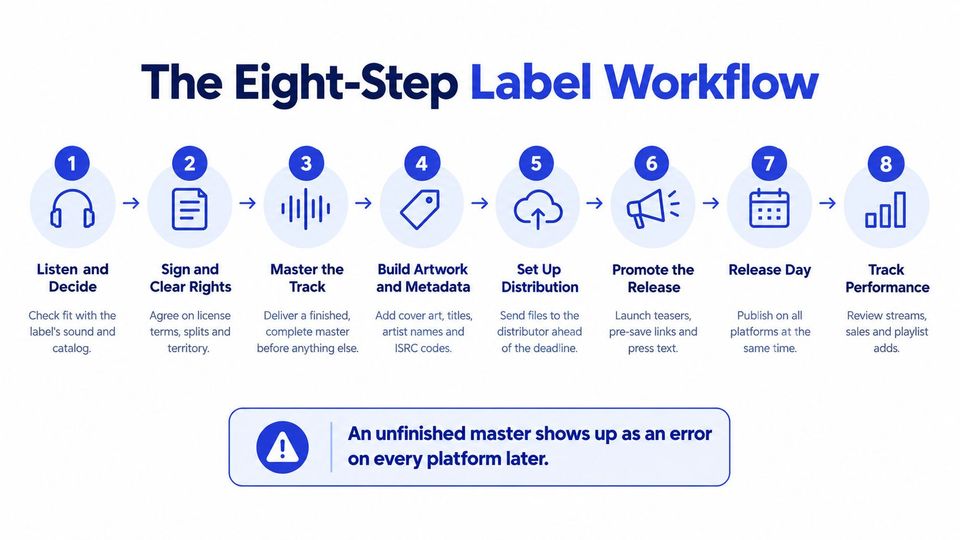
Run the release in a fixed order, even when you handle several jobs yourself. An unfinished master can become the wrong store file, the wrong premiere upload and the wrong reference recording. Correcting each copy takes longer than stopping the first bad hand-off.
Keep a release sheet with the current file, responsible person and approval status. Use a shared folder for approved assets, and move drafts elsewhere so nobody has to guess which version to publish.
The workflow below shows where each hand-off belongs.
You finish the recording before you send it onward
- Listen and decide. Check the track against your catalog and release calendar before replying. The label makes the acceptance decision, while the artist decides whether the proposed timing and support suit them.
- Agree the deal. Confirm master ownership, the agreement's term and the payment split in writing. Name the person who can approve changes, so a designer, distributor or curator doesn't have to settle a dispute between artist and label.
- Get the final master. Ask the mastering engineer for a delivery master and loudness report, then verify integrated loudness, or LUFS-I, and true peak. AES guidance recommends keeping maximum true peak at or below -1 dBTP at the input of lossy codecs, because reconstruction can create peaks that clip after encoding. Don't add aggressive limiting just to make the file look louder.
- Lock the identifiers. Assign the ISRC to the exact recording, then connect it to the work's ISWC, writers, publishers and performer credits in your release sheet. The IFPI ISRC Handbook distinguishes the recording-level ISRC from the composition-level ISWC, and requires distinct ISRCs for different recordings, including different mixes or edits.
You deliver approved assets against a shared schedule
- Deliver to stores and listening services. Send the approved audio, artwork and metadata through your distributor, using its stated delivery lead time. You control the submission, but the distributor and destination services control their processing, so don't promise a rushed release before checking those deadlines.
- Plan the premiere and promotion. Prepare the teaser, artwork, press text and agreed first-public-listen date. The label supplies accurate assets, while the curator controls editorial acceptance and the publication slot on their channel.
- Release and publish. Check the live store pages and promotional posts against the release sheet rather than assuming a successful upload means a correct release. Test links, inspect credits and confirm that the intended version plays before sending listeners to it.
- Review the results. Record reach, saves and sales alongside campaign costs and any delivery problems. Use those notes to choose the next channel or change the next hand-off, rather than judging the whole campaign by its busiest post.
Practical rule: Approve the sound before you assign the recording's identity, and approve the assets before you schedule publication.
A different edit or mix needs its own recording identifier. Correcting descriptive metadata for an identical recording doesn't require replacing its ISRC. That distinction is why you lock the master before assigning codes, then keep a clear record of later changes.
Labels protect the recording before any premiere goes live
Posting a track on a large channel doesn't give that channel ownership of the recording. Reach and rights are separate, even when the curator charges for the placement.
SoundCloud's Terms of Use state that uploaded content remains owned and controlled by the uploader, not SoundCloud, and that reposting, playlisting or making another user's track available offline gives a curator no ownership rights. The terms also restrict reuse outside permitted features, an applicable licence or the uploader's express written consent.
Record written permission to publish, including the approved recording, channels and permitted use. The artist or label supplies the authorized files, while the curator decides whether to publish and when. Payment for promotion doesn't transfer copyright.
You settle claim handling before the upload
On YouTube, rights holders supply reference files that Content ID checks against uploads. According to YouTube's Content ID guidance, the owner can choose to monetize, track or block a match.
That means an authorized premiere can still receive a claim. The important question is whether the result matches what the owner and curator agreed, not whether the upload avoids every automated match.
Say you approve a YouTube premiere, but your distributor applies a blocking policy to the recording. The curator can hold written permission and still face an unavailable video. Ask the party managing Content ID how the approved upload will be handled before announcing it.
A music copyright checker can help you understand checking options, but a tool result doesn't replace permission. You still need a record showing who authorized the use and who can resolve a claim.
Keep this checklist beside the booking:
- Written permission. Save approval for each track and the intended publication channels.
- Delivered master and ISRC. Match the owner's approved recording to the file you receive.
- YouTube policy. Record whether the owner expects monetization, tracking or blocking, and name the claim contact.
- Booker's authority. Get confirmation that the person submitting the track holds the rights needed to authorize the upload.
If the booker can't confirm authority, hold publication. A vacant calendar slot costs less work than a rights dispute after your audience has received the post.
Labels promote each release across several platforms in stages
Build promotion around before release, premiere day and after release. Give each stage a purpose instead of posting the same clip everywhere and hoping repeated exposure turns into listeners.
Keep the campaign schedule visible while you prepare assets.
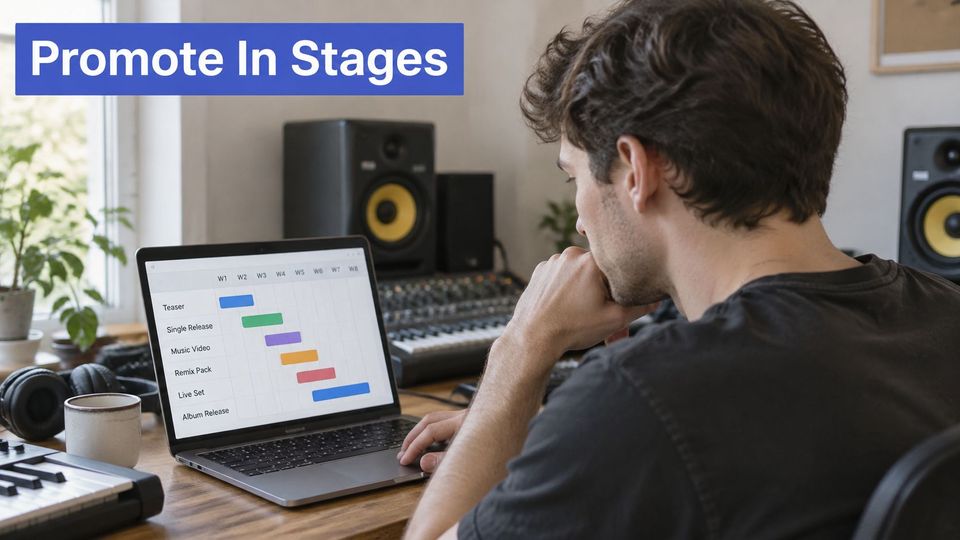
Before release, use teasers, pre-save links and press text to give interested listeners somewhere to go. Put the artist name, track title and listening date in the asset, not only in a caption that may disappear when someone shares it.
You give each stage a distinct job
On premiere day, publish the agreed first public listen, often a full SoundCloud track with artwork and a short story about the release. The artist follows the channel owner's booking link, chooses the promotions offered, and sends the release title, music streaming link and a short message.
The curator approves or rejects the request before the booker uploads audio, artwork and press text. Premierely is a premiere booking system that handles this queue and automatically schedules and publishes approved bookings; publishing the same premiere to connected SoundCloud, Instagram, YouTube and TikTok channels from one approval is a Pro feature. The curator still controls the editorial decision.
After release, give each destination its own format and listening link. When comparing music marketing services, check the actual deliverables rather than treating a repost and a produced video as the same purchase.
For help comparing creative tools, AIMVG's guide to the best AI tool for promoting songs offers a starting point. You still need to approve the output, check asset rights and keep the music central.
Use the video below alongside your campaign planning.
You check music permission for the use you plan
TikTok's commercial music guidance directs promotional posts to its Commercial Music Library, described as containing 1 million pre-cleared songs, because its licences outside that library don't cover commercial use. If you use original sound or music outside it with content disclosure enabled, the Music Usage Confirmation requires you to confirm that the content contains no protected music or that you've obtained and paid for all required licences.
Record a date and format beside each music rule before scheduling. Don't assume an artist's permission alone covers every right needed for every commercial use.
Platform formats and music rules
| Platform | Format for this stage | Music rule |
|---|---|---|
| SoundCloud | Full audio with artwork at the booked time; record publication date | Uploader keeps ownership; obtain written permission |
| YouTube | Landscape video and vertical Short; record each date | Rights holder's Content ID policy decides monetization, tracking or blocking |
| Vertical Story; record publication date | Confirm permission covers the recording, composition and planned promotional use | |
| TikTok | Vertical video; record publication date | Use the Commercial Music Library for promotional posts, or secure all required licences |
Labels measure discovery beyond raw stream counts
A premiere on a small channel can produce modest plays and still bring listeners who follow the artist later. If you judge it only by the public play counter, you miss actions that may matter more to the next release.
Discovery crosses services. The DiMA streaming report finds that three-quarters of streamers also use social media to interact with artists or music services. A listener can encounter your teaser socially and do their listening elsewhere, leaving separate records rather than a complete path.
Four stages to measure a release promotion
| Stage | What to measure | Where to find it |
|---|---|---|
| Reach | Unique listeners and views for the premiere post | SoundCloud and YouTube analytics |
| Qualified discovery | Saves, new follows and artist profile visits | SoundCloud track stats and artist profile pages, where available |
| Conversion | Email or download opt-ins and paid downloads | Download gate reports, email list and store dashboard |
| Retention | Repeat plays and listening to other catalog tracks later | Streaming artist dashboard across the catalog |
You compare placements within the same window
Choose a review window before the campaign starts. For example, compare free and paid placements over 14 days after each premiere, rather than comparing a mature upload with yesterday's post. That's a reporting choice, not a benchmark for success.
Report each channel separately. Show what it cost, what it published and which actions you can observe, then assess whether the placement brought listeners who fit the artist.
Use Crowbert's guide to social media KPIs to help choose social measures that match the campaign's purpose. A post meant to send people to a premiere needs a different judgement from one meant to collect email sign-ups.
Treat a later rise in listening as a possible contribution from the campaign, not proof that a particular post caused it.
A playlist addition, artist announcement or unrelated share can affect listening during the same period. Note those events in the report, and don't add audiences from separate services as though every listener were a different person.
You keep a baseline and repeat the check
Record follower and play counts before the premiere. As a practical reporting schedule, check the same figures on day 1, day 7 and day 30, using the same account views and definitions each time.
Save exports or screenshots with the release record, and note any metrics you can't access. If a curator supplies only public plays, say that plainly instead of estimating saves or conversions.
Your next booking decision should follow the campaign's purpose. A placement that brings relevant followers may deserve another test, while a large view count with no clear listening action may need a different creative asset or destination.
Curators and artists ask these questions about labels
Does a premiere channel own a track it reposts?
No. A repost doesn't give the curator ownership of the recording, and paying for a placement doesn't change that. Keep the permission to promote separate from any recording agreement.
Who keeps the master after a licence deal?
The artist keeps ownership, while the label receives permission to release the recording for the agreed term. The artist may receive a fee or advance plus a royalty share. Write down what happens to live releases, reporting and delivery access when the term ends.
Why did my premiere get a YouTube claim?
Content ID may match the upload to a rights holder's reference recording. Ask the party managing those rights whether the claim matches the agreed policy, and send them the upload details and written authorization. Don't assume a claim means the curator owns anything.
Which music can I use in a TikTok promo post?
Use the Commercial Music Library for promotional content, or confirm that you hold all required licences for the music you choose. Access to a song in an app isn't enough to establish permission for commercial use.
Put written permission, the delivered master and deal terms in the release record before setting a premiere date. That gives everyone a clear basis for publishing, paying and resolving problems.
Premierely offers a booking system for premiere and repost requests, with curator approval, booker-supplied assets and scheduled publication. Visit it to set up your booking process, and keep the approved master and written permission ready before you accept the next release slot.