Your Friday starts with a release to schedule and a stack of unanswered messages. Some artists want a premiere slot, some agencies offer paid placements, and some people just ask if you still take reposts. The inbox is a bad editor. It rewards whoever wrote last, not the track that fits the channel.
This list sorts seven common ways people handle indie music promotion. It splits two groups that get mixed up. Artist-side services sell a chance at coverage. A curator-side booking system lets you run the queue yourself. For each option, ask who pays, what the payment guarantees, and how much admin the work creates.
If you publish every week, you already know attention is the scarce part. Distribution got easier years ago. By 2011, more than 400 companies were helping independent acts reach stores such as iTunes and Amazon, while Bandcamp was adding about 25,000 artists a month and had generated more than $7.3 million in artist sales that year, as Businessweek reported on indie marketing. Listeners can still discover new indie music in lots of places. The slot that pays you back is the one that turns a listen into a save, a follow, or a sale.
1. Premierely keeps the premiere queue in one place
You share one booking link instead of sorting DMs. The artist picks the premiere, repost, Instagram story, YouTube video, or TikTok post you sell, each at a price you set or free, then sends the release title, a streaming link, and a short message.
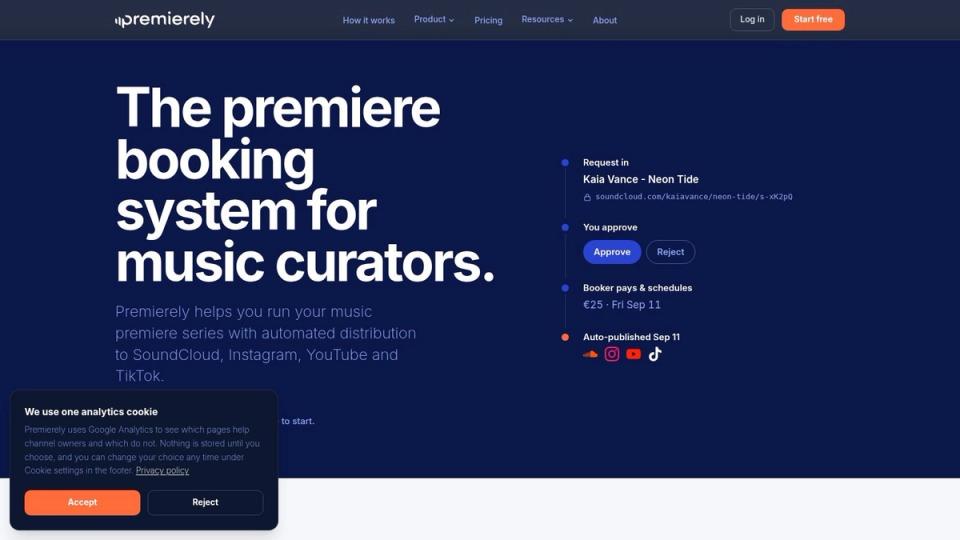
You approve or reject from one queue. The booker uploads the audio, artwork, and details only after you say yes, so a rejection never leaves files in your email. Payment happens on your own booking page in the same step, with Stripe handling checkout. The Free plan already covers the shareable premiere and repost form, a booking calendar, repost automation including instant repost, and Stripe payments.
One approval posts the channels you already run
Free and Plus plans publish to one channel you choose. Pro publishes the same premiere to SoundCloud, Instagram, YouTube, and TikTok from that single approval. Each destination gets its own format from your templates: audio and a formatted title such as 'Premiere: Artist - Track [CATALOG ID]' on SoundCloud, a vertical Story on Instagram, a horizontal video plus a vertical Short on YouTube, and a vertical video on TikTok.
The Plus plan costs €5 a month. It adds unlimited download gates, lead capture with SoundCloud handle and email, CSV export, branding, a custom domain, notifications, webhooks, gate analytics, and unlimited link-in-bio links. The Free plan includes up to three active download gates.
Gino Gagliardi built the system as the internal tool for his label Märked, and he still runs that label's premieres and reposts on it every week. When a channel declines a booking, the request appears in a shared pool that all curators can browse for free, filtered by genre and service. Genre email alerts flag new entries, and any channel can claim the booking at its own prices.
Download gates turn a free download into followers. A fan follows, likes, reposts, or comments on SoundCloud, or takes an action on Instagram, YouTube, Spotify, Bandcamp, Facebook, or TikTok, before the file opens. On Plus, those gates also capture leads the curator owns rather than just a play.
Practical rule: Use a booking system when you already have the audience. You keep the yes and the no. The artist pays for a slot you agreed to run, not for a vague promise that someone might listen.
2. SubmitHub lets artists pick each outlet
SubmitHub is the artist-side opposite of a curator queue. The artist searches bloggers, playlist curators, and influencers, then pays credits to send a track. You still decide whether to cover it. A paid submission does not buy the premiere.
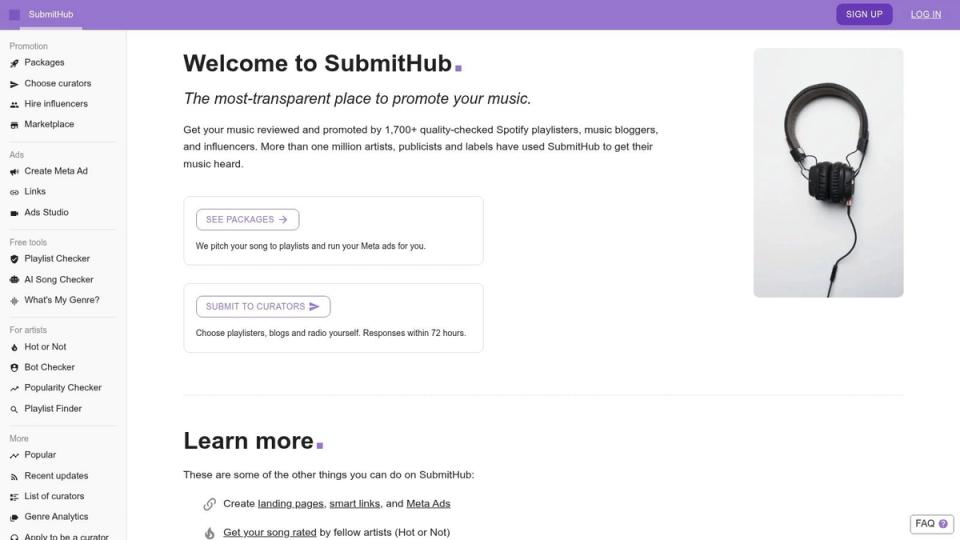
Premium submissions come with response and listening rules, and credits come back if those rules aren't met. Free submissions exist too. That structure is clearer than a cold email, because both sides know a reply is part of the deal. Coverage is not.
Who should spend the credits
This fits an artist who wants to test outlet fit without hiring a publicist. It creates admin on the artist side, because each curator still needs a look, and credit prices vary. Confirm the total before you send a batch. If you run the channel, treat these pitches like any other request. A credit spent on you is not a reason to premiere a track that misses your sound.
Artists who are also trying to submit music to record labels should keep the same standard. A submission fee buys a hearing and, on premium, a response. It does not buy a feature, a playlist add, or a lasting fan.
3. Groover sells a response, not a placement
Groover is a contact marketplace. Artists filter curators, radio, labels, and other pros by genre, pay in Grooviz, and send music that can be unreleased, scheduled, or already out. The company says contacts have up to seven days to respond, and credits come back if they don't. One Grooviz is listed at €1. Many contacts cost two, and some cost more.
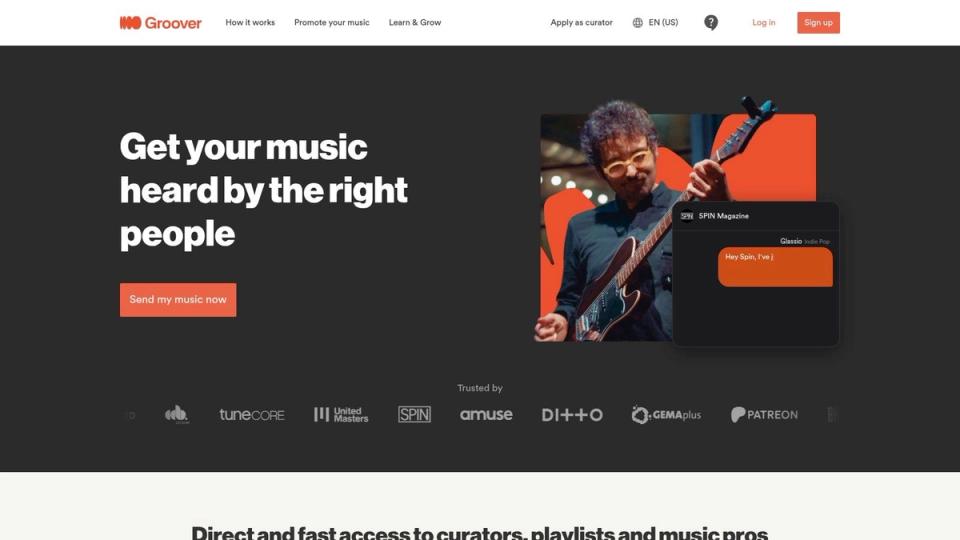
The seven-day window is the useful part. You aren't stuck on a silent inbox, and an ignored pitch costs you nothing after the refund. The ceiling is just as plain. Grooviz buy a listen and a reply, and that reply can be a polite pass. No credit commits the contact to a playlist add, a spin, or a post.
Run these checks before you pay
Check three things before you spend on any contact. Read the curator's recent coverage and confirm your genre appears there, not just in their filter tags. Look at where their audience sits, because an outlet read mostly in one territory will not move streams elsewhere. Then write a different note for radio than for a playlist. Those are different products, and a generic pitch tells a busy contact you sent the same message to fifty others. Repeated sends add up fast, so spend the two Grooviz where the fit is real.
4. Musosoup opens a campaign, then you pick offers
Musosoup flips the order. You submit for review at no charge. If the track is approved, a campaign fee listed at £42 opens offers from blogs, playlists, radio, and social outlets. Curators can offer paid or free coverage. You accept the ones you want. Reporting collects what ran and who ran it.
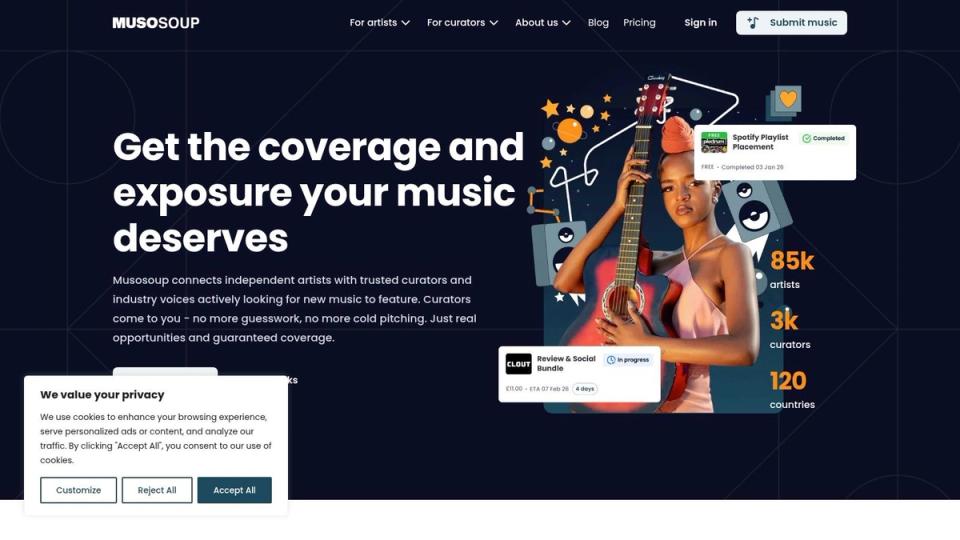
The fee does not force any named outlet to cover you. Extra paid offers raise the bill, and nothing starts until the music is approved. That is a better shape than a fixed bundle you can't refuse, and a worse shape than a slot you already booked with one curator.
Check whether the audience travels
A campaign that only hits one country can miss the listeners who stream the genre. European artists received 28 billion global discoveries on Spotify in 2024, and Australian artists generated more than 80% of their Spotify royalties from listeners outside Australia, according to coverage of Spotify's Loud & Clear report. When you accept an offer, ask which territory it reaches, not only what format it is. A review, a playlist add, and a social post are different products. Price them that way.
5. Playlist Push runs a managed playlist campaign
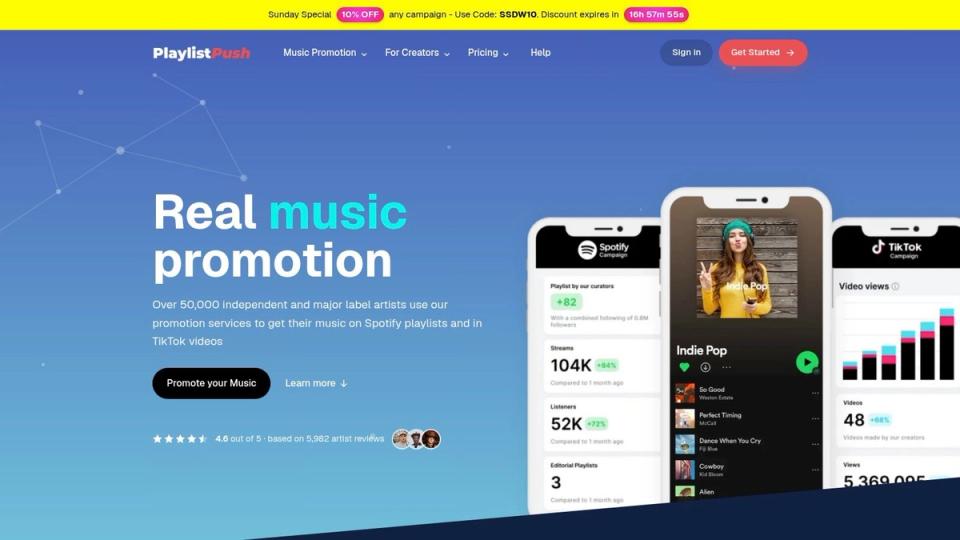
Playlist Push is for a release that already has a budget. It pitches Spotify playlist curators and TikTok creators. You apply online, and the campaign is aimed by genre. Curators still decide. Nothing in the fee guarantees an add.
Spotify campaigns list a minimum of $280, and the final price depends on genre and which curators are in the set. A pricing calculator gives the estimate before you commit. That is more managed than sending one credit at a time, and it is too steep for many first releases.
Social video is large enough that a TikTok add-on isn't a toy, but it isn't the whole release. MusicWatch counted 103 million U.S. music listeners on social-video apps, spending nearly an hour a day with music inside those apps. TikTok was 29% of weekly social-video hours, YouTube Shorts 26%, and Instagram Reels and Facebook Reels 18% each, as Musically reported. One caption will not fit all four. If you are comparing Spotify playlist routes, ask how many curators are contacted and what report you get when they pass.
A minimum budget buys outreach. It does not buy saves, repeat listens, or a follower who comes back next week.
6. RepostExchange stays inside SoundCloud
A repost helps only when the account behind it has listeners in your lane. RepostExchange is a SoundCloud member network for reposts, campaigns, and feedback. You earn credits by taking part, or you buy them. There is a free tier, and the site calls itself a SoundCloud partner. Paid options and limits change, so check the site before you budget.
The admin is the tax. Credits can expire if you go quiet, and a swap can put your track in front of members who joined for the same reason you did. Payment buys access to the pool, not a guaranteed listener. For a curator running a channel, a repost you chose is cleaner than a credit swap you didn't.
Don't bet the release on one network
Discovery is split. A global MIDiA Research survey of more than 10,000 people found that 52% named YouTube among their top three places to find new music, compared with 40% for streaming services and 37% for TikTok, Musically noted. A SoundCloud repost can still be the right move for an electronic premiere. Put it next to YouTube and your own list. If a service asks for money to place a track on someone else's channel, read SoundCloud's current rules first and ask how the placement complies.
7. Music With Depth PR sells a team, not a login
Music With Depth is a managed publicist. Campaigns for singles and albums can mix press, blog outreach, playlist pitching, and social promotion. The company says its CEO watches the work and that you get updates. Listed packages include a $595 two-week sampler and a $6,995 16-week campaign.
You are paying for coordination. That helps when you don't have hours to pitch, and it costs far more than a self-serve credit. A retainer still does not guarantee a specific blog, a playlist add, or follower growth. Before you sign, write down the outlets, the report you will see, and whether ads are extra.
This is the wrong first spend for an artist who has never tested a niche curator. Use the short sampler only if the written deliverables match the release. A long campaign that can't name its targets is an expensive maybe.
How the seven options differ on model, payment, and best fit
Six of these sell the artist a chance at coverage. Premierely sits on the curator's side: the channel owner runs the queue, sets the prices, and approves what publishes.
| Item | Main model | Who pays | Free option | Best for |
|---|---|---|---|---|
| Premierely | Booking system for curator channels; approved premieres publish to SoundCloud, Instagram, YouTube, and TikTok | Bookers pay the price each curator sets, or book free where offered | Free plan: shareable premiere and repost form, booking calendar, repost automation, Stripe payments, declined-booking pool, up to 3 active download gates | Channel owners who want requests, payments, and publishing in one queue |
| SubmitHub | Self-serve submissions to bloggers, playlist curators, and influencers | Artists pay per submission using credits | Free submissions available | Artists who want to choose outlets and manage pitches themselves |
| Groover | Credit-based pitching to curators and music professionals | Artists pay with Grooviz credits per contact | No free option stated | Artists pitching to media, radio, labels, and curators |
| Musosoup | Approved campaigns offering coverage opportunities | Artists pay a campaign fee and may pay for individual offers | Submission is free; campaign activation requires a fee | Artists seeking several types of coverage and choosing offers |
| Playlist Push | Paid Spotify playlist and TikTok campaigns | Artists or teams pay campaign costs | No free option stated | Artists or labels with a dedicated campaign budget |
| RepostExchange | SoundCloud reposts, campaigns, and feedback using credits | Users earn or purchase credits; paid plans are available | Free tier available | Artists focused on SoundCloud promotion |
| Music With Depth PR | Managed music publicity campaigns | Artists pay for campaign packages | No free option stated | Artists seeking hands-on PR support with a larger budget |
Pick the route that matches who pays and who runs the queue
If you run a premiere or repost series, start with the booking system in the first item, since it moves requests into one queue you approve. If you are an artist, treat every paid offer as a purchase of a chance, and ask what gets delivered before you send money. Test any new tool on the free tier first, because the Free plan publishes to one channel and allows three active download gates.
Independent artists and labels generated more than $5 billion on Spotify in 2024, about half of royalty payouts. Roughly 12 million artists uploaded at least one track, and about 274,000 made more than $1,000, according to RouteNote's Loud & Clear write-up. Most pitches will not clear that line. A small curator in the right genre can beat a wide campaign that sends the wrong listeners.
Money is the constraint, not a lack of tactics. Financial limits were the leading challenge for 64% of independent musicians in 2025, and 77.8% earned less than $15,000 from music. Instagram was the most-used platform at 82.2%, with YouTube at 75.6%, in the Xposure Music industry report. High use does not prove either app converts this release.
Questions worth asking before you pay
Does the fee guarantee a premiere? No. SubmitHub, Groover, Playlist Push, Musosoup, and a PR retainer sell a hearing, an offer, or outreach. The person who programs the channel still decides.
Is TikTok enough on its own? Reporting on Luminate and MIDiA found that 84% of songs on the Billboard Global 200 first gained traction on TikTok, while only 12% of all consumers were 16 to 24 year olds who mainly discovered music there. Keep YouTube, SoundCloud, and a direct list in the same week.
What should you count? Saves, repeat listens, follower growth, email capture, and sales. A repost total alone does not show that the listener stayed.
The takeaway is simple. If you own the channel, run the queue and get paid for slots you approve. If you are pitching, buy the smallest test that names a real outcome, then stop when the listeners aren't the ones you wanted.
Premierely is a booking system for curators who sell premieres, reposts, and download gates from one link, then approve the queue and publish the slots they accept. It fits indie music promotion when you would rather schedule a release than dig through unanswered messages. See how the queue works at Premierely.