You have a finished track, a release date on the calendar, and a list of promoters that grows longer every hour. One contact books clubs, another runs a SoundCloud premiere channel, and a third pitches playlists. They all call their work promotion, but they sell different things, carry different risks, and answer to different measures of success. You save time and money when you pick the promoter by the outcome you need first.
Match your release goal to the right promoter type
You face the same choice each week when new requests land and artists ask for “promotion” without naming a result. Promoters of music now split between people who sell seats for live shows and people who sell slots on digital channels. A concert promoter can't run your premiere well, and a premiere curator can't fill your venue well. Start with the table, then match your goal to one row before you contact anyone.
The table shows who sells what
| Promoter type | Main job | Who usually pays | Output you receive | Main trade-off |
|---|---|---|---|---|
| Live concert promoter | Books venues and artists, sells tickets and carries event risk | Ticket buyers and ancillary income such as parking and merchandise | A booked show and ticket sales | Often needs a guarantee or door deal, and costs can outweigh sales |
| Independent radio and press promoter | Pitches releases to radio, blogs and press | Label or artist fee | Radio spins and press coverage | Results depend on outlet decisions outside the promoter's control |
| Digital premiere or repost curator | Runs premiere and repost slots on SoundCloud, YouTube, Instagram or TikTok | Artist booking fee, or free slot if the curator offers one | A scheduled premiere, repost, story or video | Value depends on the channel's audience fit and follower quality |
| Playlist curator | Adds tracks to playlists that listeners follow | Often a per-placement fee or unpaid, depending on the curator | Playlist adds and streams from followers | Playlist reach fades, so results need measuring after the add |
| In-house label promoter | Plans and runs campaigns for the label's own releases | Label payroll | Campaign plan, outreach and reporting | Serves the label's catalogue only, not outside artists |
Read across each row, not down the first column. The main job tells you what the person controls, while the main trade-off tells you where your money can fail. A live promoter controls the room, the date, and ticket sales. A radio promoter controls the pitch, but a station decides whether the track plays. A playlist curator controls one add, but listeners decide whether they stay, skip, or save the track.
You pick the row by naming the outcome first
- You want ticket sales: Start with a live concert promoter and expect talks about a guarantee or door deal, venue costs, and advance sales.
- You want first listens and follows: Start with a digital premiere or repost curator and confirm who holds the rights before you send files.
- You want playlist adds: Look for a playlist curator who shows past placements you can open and check yourself.
- You want radio and press: Use an independent radio and press promoter and ask which outlets fit your genre, not how many emails they'll send.
Before you write to anyone, answer three short questions. What is the goal, what can you spend, and which rights do you hold? Those answers cut most lists fast, because each promoter type asks for different details. A concert promoter asks about draw, set length, and past ticket sales. A digital curator asks for a private link, a release date, artwork, and press text.
Choose one outcome per campaign. A promoter who promises every outcome at once usually measures none of them well.
You can also search a channel directory where artists and labels filter by genre and service and book premieres directly, which beats cold messages to channels that don't post your sound. If you're comparing firms rather than single channels, read this guide to music promo companies and what they sell and keep the same three questions in front of you. The right match matters more than the length of your list, because a short list of genre fits produces real replies while a long list of big names produces silence.
Concert promoters carry the financial risk before the first ticket sells
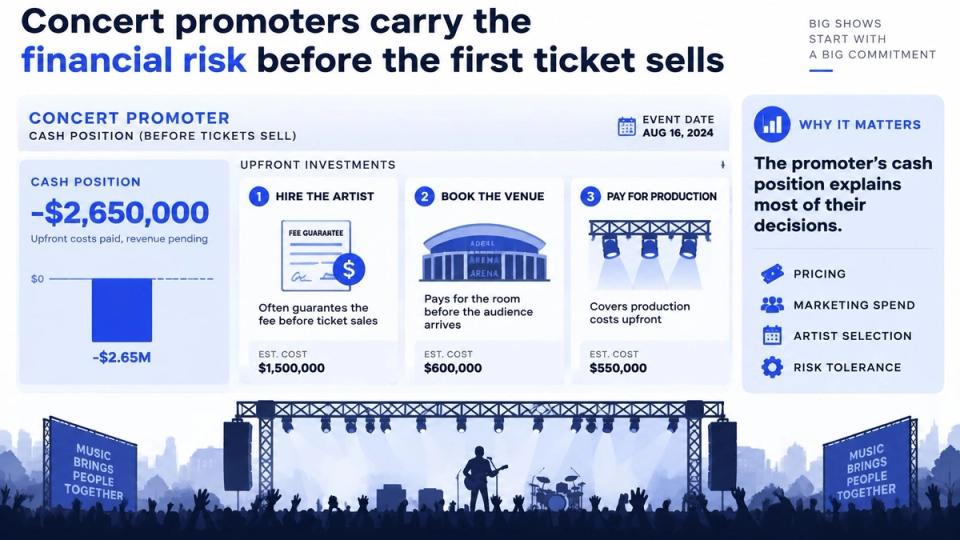
A concert promoter starts the week in debt to the show. They hire the artist, often guarantee the fee, book the venue, and pay for production, staff, and marketing before the first ticket sells. That cash position explains why they push hard on advance sales and why they lose interest fast when a show stalls.
The infographic below breaks the upfront costs into the three payments that shape every later decision.
One worked example shows how thin the margin gets
Say a room sells 1,000 tickets at $30, so ticket sales bring in $30,000. In the industry model described by academic research on the North American live-music economy, artists commonly receive about 85% to 90% of ticket revenue. That leaves about $3,000 to $4,500 for the venue, staff, production, and marketing before any other income arrives. These figures are illustrative, so run the same math with your own ticket count and costs before you argue about a fee.
Parking, merchandise, concessions, and ticket fees help close that gap, which is why promoters care about more than the door. The same research links each concert ticket with an estimated additional $25 to $50 in spending on transportation, parking, fuel, restaurants, and lodging, and that wider spend shapes how venues and cities value a show. Still, the promoter only keeps part of that spend, so a half-full room can lose money even when the street outside looks busy.
The pressure is wide, not rare. The NIVA State of Live 2025 report found that 64% of independent venues, festivals, and promoters operated without profitability in 2024. When you understand that, you stop reading a careful offer as disrespect. The promoter protects cash because one weak weekend can wipe out two good ones.
You ask three money questions before you sign
- Is it a guarantee or a door split? A guarantee pays a fixed fee, while a door split pays a share after agreed costs.
- Who pays for marketing? Get the amount and the channels in writing, since vague support rarely turns into ads or posters.
- When does settlement happen? Confirm the date, the cost list, and who holds ticket money until you get paid.
Digital Promoters Run Premieres and Reposts
Digital promoters sell slots, not seats. A premiere gives a track its first public release on a curator's channel. A repost shares a track already on the artist's profile with the curator's audience. Other offers include Instagram stories, YouTube videos, and TikTok posts, each in a different format.
The booking path runs in a fixed order
Find the curator's booking page, choose a promotion, and submit the release title, a streaming link, and a short message. The curator approves or rejects the request. Once approved, you upload the audio, artwork, and release details yourself. The system then schedules and publishes the promotion to the channels the curator has connected.
This order lets the curator assess the music before collecting files, while you provide the release assets after approval. Premierely is a booking system for music curators that manages premiere and repost requests, payments, scheduling, and publication. Accepted premieres can be formatted and automatically distributed to SoundCloud, Instagram, YouTube, and TikTok. The curator sets the available services and prices, and a scheduling calendar lets them plan premiere dates in advance. If you hire outside creators for short-form posts, a TikTok influencer agency can help with creator briefs. Confirm the rights and deliverables for each post before booking.
Possession of a file does not grant you publication rights
Buying or downloading a track does not give you permission to publish it on another profile. The SoundCloud guidance on uploading work created by someone else explains that permission from the copyright owner is still required. SoundCloud also says unreleased music remains protected by copyright and that unauthorized publication may lead to permanent account termination if a leak is reported.
Practical rule: Approval, payment, or possession of a file does not establish publication rights. Get authorization from the rights holder first.
For a premiere scheduled for next Friday, ask the label for written permission naming the track, the channels, and the date before scheduling the post. Check who owns the master, who can grant permission, and whether that permission covers every channel and date in the booking. If any answer is unclear, pause the booking.
Vet a Promoter Before You Pay Anyone
You judge a promoter by work you can open, not by claims in a message. Ask for the last three campaigns and click through the posts, playlists, or show listings yourself. You're looking for proof that the audience, the output, and the paperwork all match what the promoter sells.
Strong signals tell you the promoter runs a real operation
- Audience fit comes first: The channel or venue posts your genre often, and comments come from listeners who talk about the music.
- Past work stays public: You can find recent premieres, reposts, or shows without asking for screenshots.
- Pricing sits in the open: The booking page lists paid and free options, so you know the cost before you pitch.
- Deliverables get named: The offer states the channel, format, date, and post time in plain words.
- Terms arrive in writing: You get payment, rights, and reporting terms before money moves.
Follower counts need a second look, because bought followers inflate the number while real plays stay flat. Use a fake followers checker before you book a channel and compare followers with plays, comments, and saves on recent posts. A smaller channel with steady comments from working DJs often serves a techno release better than a huge channel with silent posts.
Red flags work the same way in live and digital deals. Walk away from guaranteed streams or chart spots, because no promoter controls listener behavior or chart rules. Refuse paid work with no written agreement, payment requests with no list of what goes live, and any promoter who won't name the exact channel or show. A real promoter names the slot because the slot is the product.
The deal table lists the terms you confirm in writing
| Term | What it means | What to confirm |
|---|---|---|
| Guarantee | A fixed fee paid to the artist whatever the turnout | Amount, due date and whether it is paid before or after the show |
| Door split | The artist receives a share of ticket sales after agreed costs | Split percentage, which costs come off the top, and when the settlement is paid |
| Flat booking fee | A fixed price for a premiere, repost or story slot | What the price includes and whether the slot is free for some bookings |
| Usage rights | Who may publish the track and on which channels | Written authorization from the rights holder for each channel and date |
| Deliverables | The files the artist supplies and what the promoter posts | Audio, artwork and press text needed, the deadline and the posting time |
| Reporting | The results the promoter shares after the campaign | Which metrics, which time window and in what format |
The guarantee and the door split carry opposite risks. A guarantee puts the risk on the promoter, since the artist gets paid even when turnout fails. A door split shares the risk, since the artist earns more in a full room and less in an empty one. If a term isn't in writing, treat it as not agreed.
Track Promotion Results Beyond Raw Reach
A big play count feels like proof, but it only shows that people pressed play once. It doesn't show whether listeners saved the track, followed the artist, or came back next week. You need a baseline and a retention check before you call any placement a success.
Research on algorithmic discovery makes the same point. The study of Spotify's Discover Weekly submitted to the UK music streaming inquiry found that algorithmic playlists could introduce listeners to unfamiliar music but generated little attachment among low-involvement listeners and only minor-to-moderate attachment among highly involved listeners. The study concluded the effects were mainly low-cost audience behaviors rather than strong evidence of broader economic success. So you report a funnel, not one reach figure.
The funnel table shows what to check and when
| Metric | What it shows | Check at |
|---|---|---|
| Qualified listens | Real listening, not a skip or a brief preview | 7 days |
| Saves per unique listener | Interest that goes beyond one play | 7 days |
| Follows per profile visit | Whether visitors become fans | 7 days |
| External click-throughs | Traffic to your own links and owned pages | 7 days |
| Retained listeners at 28 days | Fans who came back after the first burst | 28 days |
Work one ratio by hand so the report means something. Say a premiere brings 1,500 unique listeners and 90 saves, so your save rate is 6 percent. Compare that rate with the same ratio from a week without a campaign, since the baseline shows lift while raw volume only shows traffic. Record your numbers for the week before the promotion starts, or you'll argue from memory later.
Short-form spikes fade fast, so the 28-day figure carries the most weight. A TikTok post can drive a sharp burst that dies within days, while retained listeners show who stayed for the artist. Pair the placement with a place you own, such as an email signup, your artist profile, a download gate, or a link hub, so exposure turns into a relationship you can reach again. Checking your Spotify for Artists account after each campaign helps you watch saves and listener locations in one place. At live shows, tracking QR code scans at events gives you the same kind of funnel for posters and stage screens, since each scan ties a room to a link click.
How to Approach a Promoter Step by Step
You get better replies when you send fewer, sharper requests. The steps below fit digital bookings, and the last note covers how live requests differ. Keep each message short, since curators judge the track and the fit first.
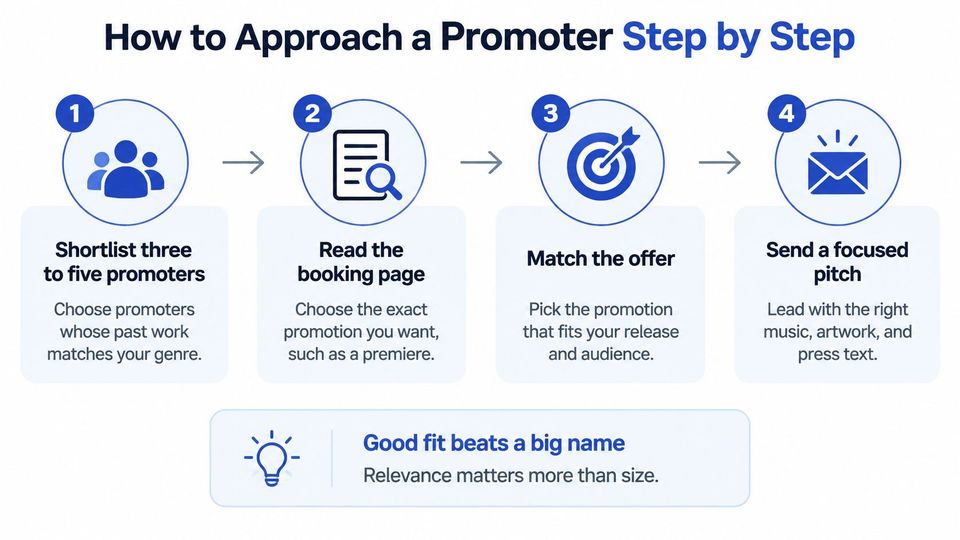
The infographic below maps the first steps, from shortlist to pitch.
You work through seven steps in order
- Shortlist three to five promoters whose past work matches your genre. A good fit beats a big name, because the audience already listens to your sound.
- Read the booking page and choose the exact promotion you want, such as a premiere, repost, or story. Don't ask the curator to design your campaign.
- Send the release title, a music streaming link, and a short message that says why this promoter fits. On a channel owner's booking link, you pick the promotions the owner sells on each channel, and that first message is what the curator reviews.
- Give the promoter a few days to reply, then follow up once. Daily nudges mark you as hard to work with, even when the track is strong.
- Confirm the date, price, rights, and deliverables in writing before you pay. This one step prevents most disputes about what was promised.
- Deliver the audio, artwork, and press text by the deadline. Late files can cost you the slot, because the curator fills the calendar with bookings that are ready.
- Ask for the post-campaign report and compare it with your own baseline. You learn which promoter to book again from that comparison, not from the first day's play count.
The short video below walks through how a booking request moves from submission to a published slot, so you can see where your files and approvals sit.
A concert promoter asks different questions, such as the show date, set length, draw in that city, and rider needs. Keep the request matched to the promoter type, since a premiere pitch sent to a venue booker reads as careless. I would rather send five matched requests than fifty copied ones, because matched requests earn replies you can act on.
Answer the questions you ask before you book
Do you have to pay a curator to get a premiere?
No. Some digital curators offer free slots alongside paid promotions. Check the booking page to see which options are available and what each includes.
Can a promoter guarantee streams or chart spots?
No. A promoter controls the placement, not how listeners respond. Treat guarantees of streams or chart positions as a red flag.
Does the curator own your track after a repost?
No. A repost does not transfer ownership. You retain your rights to the track.
Do you need written permission for an unreleased track?
Yes. Paying for a slot or sending a file does not grant permission to publish it. Get written authorization from the rights holder for each channel and date. Apply the same care when checking outside firms for a show, from sound crews to what to check before hiring security.
When should you judge a campaign?
Set a review point that fits your goal, then compare results with your pre-campaign baseline. A spike in plays alone does not show whether listeners stayed or followed through. Agree on the goal and deliverables in writing before sending files.
If you run a premiere or repost series, Premierely lets you manage bookings through one page and review requests in a central queue. On Pro, one approval can schedule posts to SoundCloud, Instagram, YouTube, and TikTok. You can start with a free booking page and set each promotion as paid or free. Visit Premierely to set up your page.