You approve a premiere request on Monday morning and feel good about the slot. By Tuesday you've sent three emails hunting for the WAV, the artwork at the right dimensions, and the press text the artist promised. Wednesday brings a second request for the same Friday, because nothing in your setup stops two people from picking that date.
None of that is music work. It's admin that piled up because your booking flow lives in email, DMs, and a spreadsheet.
This list sorts 10 tools by three questions. Who approves the request? Who uploads the files? And who publishes after approval? Most roundups group all of these as promotion services and rank them on reach, which hides a bigger divide. A real booking system turns your approval into a scheduled, published premiere. A submission or campaign service sells you a review that may never become a placement. Those are different jobs, and mixing them up costs you money and a release date.
Handing off admin is the point. The Fluidwave guide to automation and delegation covers how to pass on repeatable work without giving up the decisions that need your ear.
1. Premierely turns one approval into a scheduled premiere
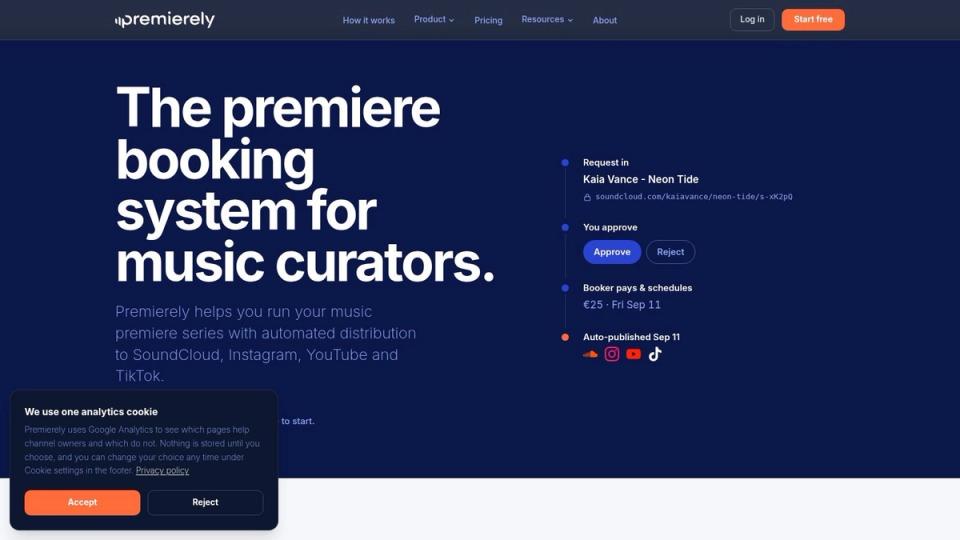
Premierely is the only tool here where the booking itself does the publishing. An artist finds your channel in the directory, filters by genre and service, picks a date, and pays on your storefront through Stripe. The release title, streaming link, and a short message arrive with the request, so you aren't rebuilding the brief from an email thread.
The workflow you get is narrow on purpose.
- One queue: every request lands in a single list where you approve or reject it.
- Booker uploads: audio, artwork, and press text arrive after you say yes, not before.
- One approval publishes: the premiere is scheduled and posted to SoundCloud, and the Instagram Story, YouTube video, and TikTok cut go out from the same approval. Multi-channel publishing is a Pro feature.
- Calendar protection: a booked date is blocked, so two bookers can't claim the same Friday.
That spread matters. The 2025 Independent Music Industry Report found 82.2% of surveyed artists active on Instagram, 75.6% on YouTube, and 71.1% on TikTok.
The limits are real. It's built around promotion channels, so it won't pitch press or radio for you, and multi-channel publishing needs Pro. Paid bookings on the Free plan carry a 5% fee plus VAT. If you want to see how other channel owners lay out a booking page, these booking website examples show the range.
2. SubmitHub sells a curator's attention, not a premiere slot
An artist can pay to send a track to selected SubmitHub curators, blogs, or influencers. Premium submissions carry a response commitment; free sends do not.
For curators, that means reviewing and responding to tracks filtered by genre and channel type. The artist gets a decision or feedback, but a positive response does not reserve a date, gather release assets, or publish the track.
Where costs stack: submissions are charged per contact. Pitching one release to twenty curators means paying for twenty submissions, whether the responses are positive or negative.
Practical rule: Set a per-release budget before sending. Treat submission fees as marketing spend, not payment for a placement.
Before paying for any promotion, check the total cost and what the fee covers. Booking fee guidance for artists focuses on deposits, staged payments, and written settlement records for live bookings. Those details differ from music promotion, but the practical habit carries over: know what you are paying for.
For a broader look at pitching options, see this guide to indie music promotion.
3. Groover puts a seven-day clock on feedback
Groover works like a pitching marketplace with an accountability clause. You search contacts by genre, type, and country, then send a track. Groover states contacts owe feedback within seven days or credits return for a non-response. That's a meaningful difference from paying into a void.
The contact range is wider than playlist-only services. Curators, radio, labels, and other music professionals all appear, so one credit balance covers several kinds of opinion.
- On the curator side: joining as a contact means another inbox with a deadline someone else sets. If your week already runs on premiere dates, a second queue of unreviewed tracks is a real cost.
- Pricing: popular contacts cost more credits, and discount packs only help if you send often.
- Scheduling: out of scope. Groover won't hold a release date, collect artwork, or publish anything.
A reply that says "I'd love to feature this" still lands in your email, and you still build the premiere by hand, file by file.
Nothing here replaces a calendar. Feedback is a conversation, and conversations don't block double bookings.
4. RepostExchange trades engagement for credits
RepostExchange runs on a credit economy scoped to SoundCloud. You earn credits by engaging with other artists' tracks, then spend them to get reposts and plays on your own. A community layer of feedback and networking sits on top, plus optional paid plans if you'd rather buy credits than earn them.
The credit model is the whole product.
The appeal is the free entry point. An artist with time and no budget can run a campaign without spending a cent. The cost shows up as hours, because earning credits means listening and reposting on a schedule that isn't yours.
For a curator, this is a different animal from a booking. There's no service page, no price you set, no date selection. Reposts happen on the community's rhythm, which means you can't promise a slot to anyone.
The other limit is reach quality. A repost from someone farming credits isn't the same as a slot on a channel whose audience follows its taste.
SoundCloud audiences don't live only on SoundCloud. A 2025 industry-statistics compilation reported that YouTube generated approximately 53.45% of SoundCloud's social referrals, with Instagram at 15.67% (SoundCloud statistics). Those come from a secondary compilation rather than platform-owned analytics, so treat them as directional. The point holds either way: a SoundCloud-only push leaves discovery paths untouched. If you want the paid version of this workflow, here's how a proper SoundCloud repost service is built.
5. Musosoup starts with an accepted release, then sells coverage
Musosoup runs on a campaign model. You submit a release for review, and if it's accepted you can activate a campaign that puts it in front of blogs, playlists, radio, and influencers. Curators then make offers, and you choose which paid or free opportunities to accept.
The useful part is the menu. Instead of hunting ten outlets and guessing at their rules, you get interview requests, reviews, features, and radio spots in one place and decide which ones fit the release.
The annoying part is the fee structure. A campaign fee applies after acceptance, and individual coverage can cost extra on top. Budget for both or the second invoice will surprise you.
Timing matters more than many plan for. SoundCloud's own guidance recommends starting promotion two to four weeks before release, with teasers and pre-saves building anticipation (SoundCloud's independent promotion guide). A campaign that opens on release day has already missed that window.
As a curator, Musosoup isn't your tool. It's a marketplace for coverage offers, not a place where someone books a Friday premiere on your channel and hands you finished assets.
Campaign services sell possibilities. Booking systems sell dates.
6. DailyPlaylists keeps playlist pitching inside Spotify
A release already on Spotify can be sent to independent playlist curators through DailyPlaylists. You submit the track, and each curator decides whether it fits their playlist.
The free standard-submission option lets artists try curator pitching before paying. Paid premium submissions offer a response commitment, while playlist placement remains the curator's decision.
The workflow has clear limits. The track must already be live on Spotify, so it does not suit pre-release submissions. DailyPlaylists handles playlist consideration, not the collection of artwork or the scheduling and publishing of a premiere across platforms.
For a premiere curator, that distinction matters: a Spotify link and a playlist decision do not provide the release assets or publishing workflow needed for a channel premiere. Streaming accounts for a large share of recorded-music revenue, according to IFPI's State of the Industry 2025 report. Artists therefore have reason to pitch playlists, but a Spotify submission is not a booking request for your SoundCloud channel. Tell bookers which links and materials you need.
7. Playlist Push runs the outreach at campaign scale
When an artist has a release ready but little time to find contacts, Playlist Push runs outreach to matched Spotify playlist curators or TikTok creators. The artist sets a budget and describes the track and genre. Curators are paid to review, not to place, and the company says results are not guaranteed.
That makes the service a way to buy consideration at volume, rather than a booked slot. The trade-off is the minimum spend: Spotify campaigns require a set budget, which can make a test costly for an independent release.
TikTok adds another route for discovery. MIDiA Research reports that it leads music discovery among consumers aged 16 to 24, ahead of YouTube and streaming services (MIDiA Research). Fewer than a quarter of that age group ranked TikTok as their single top method, so it is one channel to consider, not the only one.
For curators, Playlist Push does not fill a premiere queue. It handles outreach to other people's playlists and creator networks, not booking approval, asset collection, scheduling, or publishing to your channel.
Ask first: what am I paying for if no curator says yes?
8. SoundCampaign bills for reviews, not placements
SoundCampaign sells campaigns across Spotify curators, TikTok creators, and Meta ads. You set a budget, pick genres, and the service distributes to matched contacts. The pricing page says payment covers completed reviews, and amounts for reviews that never happen are credited back.
That billing model is the most interesting thing about it. You pay for the review to occur, which is a cleaner promise than "we'll get you on playlists." A campaign that lands nowhere still returns a set of completed reviews you can learn from.
- Spotify campaigns: matched playlist curators, billed per completed review.
- TikTok promotion: creator campaigns run through the same budget flow.
- Meta ads: paid social handled inside the service rather than in Ads Manager.
The limit is the same one every campaign service has. Payment for a review doesn't guarantee a playlist add or meaningful reach, and the budget estimator produces projections, not outcomes. Read the estimate as a ceiling on spend, not a forecast of results.
As a curator, it's not a fit. No booking form, no date selection, no publication on your channel. If your problem is filling Friday slots with music you'd run, a campaign service answers a different question.
A review is a receipt for attention. It isn't a premiere.
9. Hypeddit captures the listener after the click
Hypeddit is a toolkit rather than a marketplace. Smart links, pre-saves, download gates, email capture, and ad tools sit in one account, with a free entry tier and paid plans for fan data and analytics.
The download gate is the piece worth understanding. A visitor hands over an email address, and can be asked to follow you on Spotify or SoundCloud or subscribe on YouTube, before getting the file. A music-marketing guide reports a typical conversion range of 30% to 50% of visitors for a well-targeted gate, while noting results vary by audience and offer (download gates and email lists). Treat that as indicative, not a number you can bank.
That's how a premiere becomes a list you own instead of a spike you screenshot.
Two limits to plan around. Hypeddit doesn't book premieres, reposts, or playlist placements, so it sits beside a booking rather than replacing one. And the site notes that the SoundCloud API connection is paused, with SoundCloud steps in gates now voluntary, so confirm what still works before you build a gate around it.
10. PlaylistSupply hands you the contact list and nothing else
PlaylistSupply is a research tool. You search Spotify and YouTube playlists by artist, genre, or keyword, and get curator contact details back. Higher tiers add playlist-quality checks, similar-artist search, and one-click pitching from a connected Gmail account.
For a label team doing outreach every month, a contact database earns its keep. You build lists you keep, and you can re-pitch the same curators on the next release without paying per submission.
What you keep after the pitch
Everything after the search is yours. You judge fit, you write the pitch, you handle replies. Nothing gets approved, scheduled, or published, and no payment moves between you and a curator.
That's also the honest answer to the audience question. A placement on a playlist you pitched doesn't hand you listener data. What you keep is the relationship and whatever you captured yourself, through a link in bio, an email gate, or a follow request. Promotion that only rents reach leaves you with a screenshot and no way to reach those listeners again.
The subscription only pays for itself if you pitch often. For two releases a year, the math usually doesn't work.
How the booking and promotion tools compare for curators
| Item | Main purpose | Premiere or repost booking | Free option | Best for |
|---|---|---|---|---|
| Premierely | Book and manage music promotions across channels | Direct booking, with scheduling and publication support | €0 plan: unlimited free bookings, 3 paid bookings a month, 1 published premiere per day, and 1 distribution channel | Artists seeking dedicated premiere or repost bookings |
| SubmitHub | Submit music to curators, blogs, and influencers | No; submissions are not scheduled bookings | Free and paid submission options | Targeted pitching and curator feedback |
| Groover | Submit music to curators and industry contacts | No; does not offer calendar-based booking | No free option specified | Seeking feedback and industry contacts |
| RepostExchange | Promote tracks through a SoundCloud-focused community | No; uses community credits rather than channel bookings | Free entry through community participation | Artists seeking SoundCloud promotion and networking |
| Musosoup | Run campaigns for blogs, playlists, radio, and other coverage | No; offers coverage opportunities, not premiere time slots | Some offers may be free; a campaign fee applies after acceptance | Releases seeking varied media coverage |
| DailyPlaylists | Submit released tracks to Spotify playlist curators | No; playlist submissions are not premiere bookings | 10 free standard submissions per week | Artists seeking Spotify playlist consideration |
| Playlist Push | Run Spotify playlist or TikTok promotion campaigns | No; does not book premiere slots or schedule publication | No free option specified | Artists seeking managed promotion campaigns |
| SoundCampaign | Promote music through Spotify, TikTok, and Meta campaigns | No; does not book premiere slots or publication | No free option specified | Artists seeking multi-channel campaigns |
| Hypeddit | Create smart links, pre-saves, download gates, and marketing tools | No; not a placement-booking service | Free entry-level plan | Artists directing campaign traffic and capturing fan information |
| PlaylistSupply | Research Spotify and YouTube playlists and curator contacts | No; research tool only, with no booking or publication | No free option specified | Artists and labels conducting their own playlist outreach |
You choose the tool that matches your weekly work
For a weekly premiere series, the handoffs matter more than the feature list: who reviews the request, who supplies the files, and who schedules and publishes the release. Those steps separate booking systems from submission, campaign, and research services.
Approval stays with the curator. A booking system should put requests in a queue that you can approve or reject. Submission and campaign services offer other kinds of promotion, but they do not book a slot on your channel calendar.
The artist supplies the release materials. Look for a workflow where the booker provides audio, artwork, and release details after approval. That keeps those assets with the request instead of scattered across email threads.
Publication should follow approval. Check which platforms the tool connects to and whether scheduling and publishing happen automatically after you approve. A calendar can reserve a date, but it does not necessarily publish the release.
Then compare the costs. Premierely's Free plan costs €0 and includes unlimited free bookings, three paid bookings a month, one published premiere per day, and one distribution channel. Its Free plan also charges a 5% fee plus VAT per paid booking. Pro costs €10 per month and includes unlimited paid bookings and multiple publications per day. Compare the subscription and booking fees with the volume you expect.
Test one slot before moving your queue. Set up a service at your chosen price, then run a release through request, approval, payment, asset submission, scheduling, and publication. Note which steps the platform handles and which still require your attention.
Premierely is built around this handoff: artists choose a promotion and pay on the channel owner's booking page, then supply the release materials after approval. The curator approves once, and Premierely schedules and publishes to the connected platforms. Its Free plan includes a shareable booking form, calendar, repost automation, and Stripe payments. For related admin workflows, see this automation stack guide for SaaS teams.
Do I need to pay to start taking bookings?
No. Premierely's Free plan costs €0 and includes unlimited free bookings, three paid bookings a month, one published premiere per day, and one distribution channel. Pro costs €10 a month and adds unlimited paid bookings, multiple publications per day, and support for all four connected platforms.
What does a paid booking cost me in fees?
Premierely charges a 5% fee plus VAT per paid booking on the Free plan. Compare that fee with the cost of a subscription at your expected booking volume.
How do I test a booking system on one slot?
Set one service at one price, then follow a release from request through publication. Check which steps the tool handles and where you still need to act.
Can I mix free and paid bookings?
Yes. Curators can set each promotion to a price or offer it for free. Artists select the services they want on the booking page, and the request enters the same approval workflow.
Premierely combines bookings, payments, scheduling, and publication for music curators. Artists choose a promotion on the channel owner's booking page and pay through Stripe. After approval, they supply the audio, artwork, and release details; Premierely handles the subsequent scheduling and publication. If that workflow fits your weekly work, you can start with Premierely.