Tuesday morning brings the same five messages. One producer wants a repost today, one wants a premiere next month, one asks what you charge, and two promise to send the track once you confirm you're interested. Nobody names a price, a format or a deadline, so every reply costs you fifteen minutes and a favor.
The fix is operational. Artists ask vague questions because you've never published a menu, a price and an approval rule. Once those three exist, the conversation changes from "can you help me out" to "which slot do you want", and you stop working for free on your own channel.
This is the process I'd build if you run a premiere or repost series and want to get paid to promote music instead of trading favors. It starts with what you sell, moves through how you take the money, and ends with the report that brings the artist back.
Build a Menu of Paid Promotions You Can Sell
The word repost covers five jobs. One artist wants a premiere with a written intro, another wants the track pushed to your followers within the hour, a third asks for a story slide with a link, a fourth wants a YouTube upload, and a fifth wants a vertical clip for TikTok. Price all five as one favor and you'll do the most expensive job for the cheapest number.
The money is there to charge properly. U.S. paid streaming subscriptions passed 100 million for the first time in 2024, and total U.S. streaming revenue reached US$14.88 billion, up 3.6% from 2023, according to the RIAA's 2024 year-end revenue report. Promotion money now moves through platform-specific releases, channel placements, reposts and social video, which is exactly why a single repost price undersells half your work.
A short menu beats a long one.
| Service | Platform | Format delivered | What the artist gets | Pricing approach |
|---|---|---|---|---|
| Premiere | SoundCloud | Audio with artwork and a formatted title | First play on your channel, announced in your style | Your price, or a free slot you label as free |
| Repost | SoundCloud | Audio repost to your followers | Your audience sees the track in their feed | A flat fee per repost, or free for artists you've featured before |
| Instagram story | Vertical story | A slide on your account with a link sticker | Paid only, priced per story | |
| YouTube video | YouTube | Landscape video and a vertical Short | A premiere on your channel plus a Short cut | Paid only, priced above audio placements |
| TikTok post | TikTok | Vertical video | A post on your account with the sound credited | Paid only, priced per post |
Each row costs you a different amount of time. A premiere needs final audio, artwork dropped into your template, and a title in your house style. A story needs a vertical crop. YouTube wants a wide video plus a Short cut from the same footage. TikTok wants vertical again, with the first frame carrying the hook. Count the check-in time too, because that's where the week disappears.
Free slots keep the queue warm, so label them
Free placements belong in a healthy series. They fill quiet weeks, they let you support an artist you rate highly, and they give new bookers a low-risk way to see how you work. The rule is that a free slot carries the same label as a paid one, because an artist who expects a premiere and receives a repost won't book twice.
The two-service test. Pick two or three services you can deliver well every single week. Everything else comes off the page until your queue runs without gaps. A curator selling a premiere and a story, both done properly, gets more repeat bookings than one selling six formats badly.
Set Up a Booking Page Artists Can Use
A booking page replaces the thread. The artist picks a service, pays, and sends the details in one pass, so your first reply is a decision rather than a request for files.
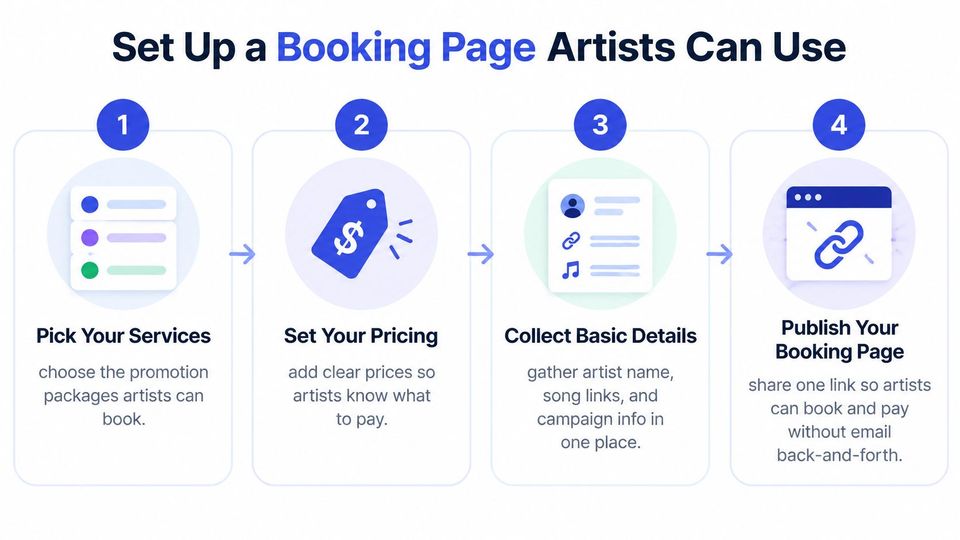
1. Publish the services you can deliver this month. Mark each one paid or free. The artist sees that label before they commit, which prevents the awkward message where you explain that the premiere they assumed was free costs money.
2. Write one line that says what the artist gets. "Premiere on the channel, Tuesday at 18:00, artwork in the intro post, and the track stays on my feed" answers more questions than a page of terms. Name the format and the day, because those two details drive most follow-ups.
3. Connect your payment account before you share the link. The artist pays on the page, and the slot is only scheduled once payment clears. Money that moves through a side chat comes with a side chat dispute, and chasing it costs more than the placement earns.
4. Ask only for what you need before you decide. Request the release title, artist name, release date and a working streaming link. A streaming link lets you listen in seconds without a download, and it works from a phone. Audio, artwork and press text are uploaded after approval, so a request you turn down never costs the artist file prep.
5. Write your queue rule down. Say who approves, how fast you reply, and what a decline means. "I reply within three working days, and a no comes with one reason" is enough. A stated rule ends the follow-up cycle before it starts.
6. Put the link where artists already ask. Bio, pinned post, and the reply to every "how do I book" message. One link saves you typing your prices again in six different chats.
Premierely is one example of a booking system that runs this flow: the artist books and pays on your page, you approve or reject from one queue, and the premiere or repost is scheduled and published after approval. If promotion is becoming real income, AI2Fin's finance planning resources for artists help with budgeting months that don't arrive evenly. For the page layout itself, the booking landing page guide walks through the structure.
Test it on yourself first. Make one booking on your own page with a card you control. You'll see the confirmation email, the payment receipt and the approval step exactly as an artist does, and you'll catch the broken link before a paying booker does.
Vet Artist Requests Before You Accept a Slot
A bad request costs more than a clear no. It costs a calendar slot, a correction after the premiere goes live, and the artist's trust when you pull the placement. Five checks catch almost everything, and they take under ten minutes.
| Request check | What to look for | Red flag |
|---|---|---|
| Rights | Artist owns the recording or has cleared every sample, remix and guest performance | Unclear ownership of a sample, remix or cover |
| Release details | Title, artist name, release date and a working streaming link | A missing link or a private file only |
| Audience fit | Genre and tone match your past bookings | A genre far from your channel |
| Payment flow | Payment captured on your booking page | Requests to pay outside the booking page |
| Promises | You sell the placement only | Requests for guaranteed streams or follows |
Run the rights check before you set a date
Ownership is the row that matters most, and monetization raises the stakes. SoundCloud limits direct monetization to original content where the uploader owns all rights, so unofficial covers, remixes, mashups, DJ sets and podcasts don't qualify, per SoundCloud's monetization rules. A track also needs to run longer than 30 seconds and shorter than 10 minutes, and review can take up to five business days.
Tell the artist that early. If they want a premiere next Tuesday and the review hasn't started, the date is already at risk. Build the review window into the slot you offer, and the artist won't blame your channel when the payout lands late. If a sample or a remix is unclear, ask for clearance before you book, and run a music copyright checker over the release to catch what the artist missed.
The decline that keeps the door open: "Thanks for sending this. I can't take the premiere because the remix rights aren't cleared yet. Send me the original when it's out and I'll hold a slot."
Accept when all five checks pass. Ask for one fix when a single item is missing, such as a private link or unfinished artwork. Decline when rights are unclear, and decline fast. A clear no protects your calendar, and artists remember the reason better than they remember a silence.
Set Prices and Collect Payment Safely
The pricing trap is copying the biggest number you've seen quoted. It usually comes from a creator with a different audience, a different format, and a team behind the posts. In 2025, mid-tier creators typically charged $200-$300 for music promotions, while top creators charged thousands of dollars, according to Digiday's reporting on music promoters and creators. That range describes the market. It doesn't set your price.
Price against three things you can count. How many listeners reach each post. How many placements you finish in a month. How long one deliverable takes, files and check-ins included. Divide your monthly target by the placements you can complete and you have a floor.
Build three tiers and keep them simple
A free slot for an artist you trust, capped at a couple each month. A standard paid placement at your floor price. A multi-platform package where the artist buys the premiere, the story and the vertical video together, priced above the single service so the extra file prep is worth your time.
The audience you're selling access to already pays for music. Streaming produced US$20.4 billion of the US$29.6 billion in global recorded-music trade revenue in 2024, and paid subscription accounts rose 10.6% to 752 million, IFPI reports. A placement fee is a normal budget line for an artist whose income depends on being heard.
Payment follows the same discipline. Capture the full amount before the slot is scheduled, and say so on the page. Refund in full if you decline, because you've sold nothing yet. Requesting partial payment before work begins is a fair middle ground for a bundle that needs artwork approvals first, as long as the terms sit on the page and aren't improvised in a message. Keep one record per booking with the date, service and amount, and month-end takes ten minutes instead of an evening.
What the fee buys: a placement on your channel, delivered on the agreed date. It doesn't buy streams, follows or a chart position, and saying that out loud saves arguments later.
Disclose Paid Placements in Plain Words
A paid premiere stops being an editorial pick the moment money changes hands, even if you only chose the track because you like it. The U.S. Federal Trade Commission treats payment, employment, family ties or receiving anything valuable as a "material connection", and that connection has to be disclosed alongside the recommendation, per the FTC's disclosure guidance for social media influencers. For video, the guidance points to three places at once: the caption, on-screen text and the audio.
TikTok's own rules point the same way. Its U.S. terms require content that promotes a third-party brand, product or service in return for payment or another incentive to follow TikTok's Branded Content Policy, applicable laws and the FTC's Endorsement Guides, per TikTok's terms of service. A repost you were paid for counts as compensated promotion whether or not it looks like an ad.
Put the label where the format can carry it
- SoundCloud premiere: one line near the top of the description, before the artist bio. "Paid premiere" is enough, and the track page keeps it visible.
- Instagram story: a text label on the slide itself, not a caption viewers never open. Place it where the link sticker won't cover it.
- TikTok and vertical video: on-screen text for the first few seconds, plus the words spoken in your first sentence if you talk over the clip.
- YouTube: the first line of the description and a pinned comment, since the description sits below the fold on mobile.
Free placements need the same treatment when you get something back. A feature swap, a guest mix or a track you keep for your own sets is value received, so label it.
Write the disclosure line once and reuse it. "Paid placement, chosen by the channel" survives every platform and reads like a person wrote it.
Show Artists Real Results With Clear Reports
A follower count tells an artist how big your channel looks. It says nothing about whether anyone listened. That gap is where paid promotion gets its bad reputation, and it is why your report has to show what listeners did, starting with whether they stayed.
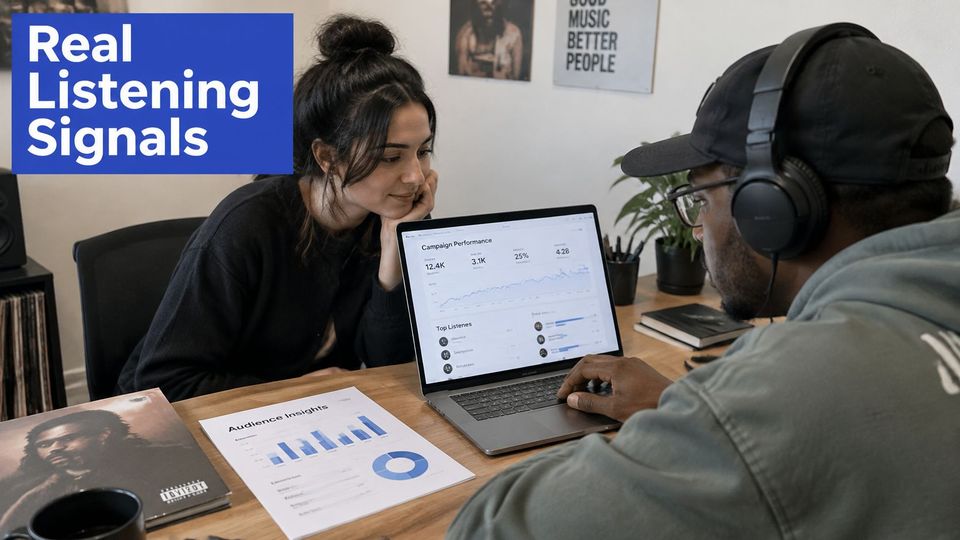
Agree the metrics before the placement goes live and write them into the booking terms, so both sides count the same things. The question that keeps surfacing in discussion of playlist pitching scams is how a buyer tells real listeners from bots, incentivized clicks and low-value exposure. Buying or inflating plays, follows or views misleads the artist, so every number in your report needs a dated screenshot behind it.
| Metric | What it shows | Red flag |
|---|---|---|
| Saves | Listeners keep the track for later | Saves far below plays |
| Follows | Listeners want more from the artist | A follow spike with no saves or repeat listens |
| Completion rate | Listeners stay until the track ends | Most listeners leave in the first seconds |
| Repeat listens | Listeners come back to the track | One play per listener and no return visits |
| Geographic match | Listeners sit in the artist's target market | Traffic from markets unrelated to the release |
| Email sign-ups | Listeners opt in to hear more | None when the artist expected leads |
Pull the platform's numbers and date them
Pull the analytics the platform already gives you for the placement window, and save a dated screenshot next to the post link. If a spike looks artificial, say so in the report and describe the pattern: where the plays came from, how fast they arrived, whether saves followed. An artist who hears the bad news from you first trusts the rest of the numbers.
Repeat listening matters more on SoundCloud than raw play count, and the payout math shows why. Fan-powered royalties calculate an artist's earnings from how much of each listener's monthly listening time goes to that artist, according to SoundCloud's fan-powered royalties guide. A placement that sends a small group back to the track three times is worth more than a wide, shallow burst.
Set refund terms for missed deliverables before you need them. A late post, a broken link or a missing story gets a full refund or a re-run, your choice, written on the page. Editorial acceptance and payment stay separate decisions, so a paid booking still gets declined when the rights are unclear. If the artist wants to watch their own numbers, point them to their Spotify for Artists account rather than handing over screenshots they cannot verify.
Keep one record per booking, in the same format every time. Placement date and channel. The agreed metrics on each side of the post. One line on who listened. One line on what you would change. Identical fields with the screenshots filed beside them turn separate bookings into a track record an artist can audit, and they give you a dated answer when a buyer asks whether your audience is real.
Book Your First Paid Promotion This Week
Open your page for one paid service and take one booking this week. Skip the full brand refresh and start with one service, one price, one approval rule, and one artist who pays through the page.
Run three checks before you share the link. The price is written on the page, so nobody has to ask. The decline rule is written down, so you know what happens when the rights are unclear. The disclosure line is saved somewhere you can paste it, so the first post goes out labeled correctly.
One approval can carry the whole placement. Premierely's Free plan costs €0 and includes unlimited free bookings, 3 paid bookings a month, 1 published premiere per day and 1 distribution channel, which is enough to test the process before you pay for anything.
Then send the artist a short summary within a week of the post going live: the date, the channel, the agreed metrics before and after, and one note on audience fit. That first booking shows you where the process jams, whether it's artwork requests, payment timing or a title format you keep rewriting. Fix that one thing before booking number two.
A paid promotion business runs on three things you can test with a single booking: clear prices, clear rules and honest reports.
Premierely is a booking system built for music curators: list the premieres, reposts, stories, videos and TikTok posts you sell, set your own prices, and approve or reject requests from one queue. The same approval that schedules a placement publishes it to the channels you've connected, so the report you send a week later describes work that went out on time. Take your first paid booking at Premierely and see where your process needs one fix.